For the past four articles, we have been building toward one idea:
The future of Liferay is not just about delivering better digital experiences. It is about helping enterprises make better decisions.
In Liferay AI: Turn Your DXP Into a Decision Platform, we explored how Liferay can evolve beyond a traditional Digital Experience Platform (DXP) into a foundation for enterprise decision-making.
In Liferay Decision Intelligence: Turn Portal Data into Action, we looked at how portal data becomes more valuable when it drives operational action.
Then came Liferay AI Governance: AI, Rules & Human Judgment
, where we addressed the critical question of accountability: how should AI, business rules, and humans work together?
Finally, Liferay Decision Intelligence: Roadmap to Enterprise AI explored how organizations can move from one AI use case to an enterprise capability without launching another massive transformation program.
Now we bring the concept down to the operational level: What decisions can Liferay and AI actually transform?
The AI Opportunity Most Enterprises Are Missing
Here is our contrarian view: Most enterprises are using AI to speed up content creation inside Liferay, when they should be using Liferay to structure and orchestrate automated decisions.
AI-generated content, summaries, chatbots, and AI search are useful. But they don’t necessarily address the biggest enterprise bottleneck. Consider an account manager trying to approve a large dealer discount. They may need to check customer history in Salesforce, inventory and margins in SAP or Oracle, contracts in PDFs, previous pricing exceptions, and internal approval rules. The information exists.
The decision is slow. That’s decision latency.
A chatbot can tell the manager what the data says. It doesn’t necessarily determine what should happen next. This is where Liferay Decision Intelligence becomes more interesting than simply adding an AI assistant.
From Information Retrieval to Decision Execution
The conventional model is: Portal → AI Assistant → Answer → Human decides
The Decision Intelligence model is: Liferay + ERP/CRM + Documents → Rules + AI → Decision → Action
Liferay provides the interaction and workflow context. Enterprise systems provide operational data. Business rules establish boundaries. AI interprets context and ambiguity. The system then determines whether to automate, recommend, or escalate.
Liferay already provides headless capabilities that enable external systems and applications to interact programmatically with the platform. Its official Headless APIs documentation provides the technical foundation.
The goal isn’t to replace the enterprise stack. It’s to make the existing stack more intelligent.
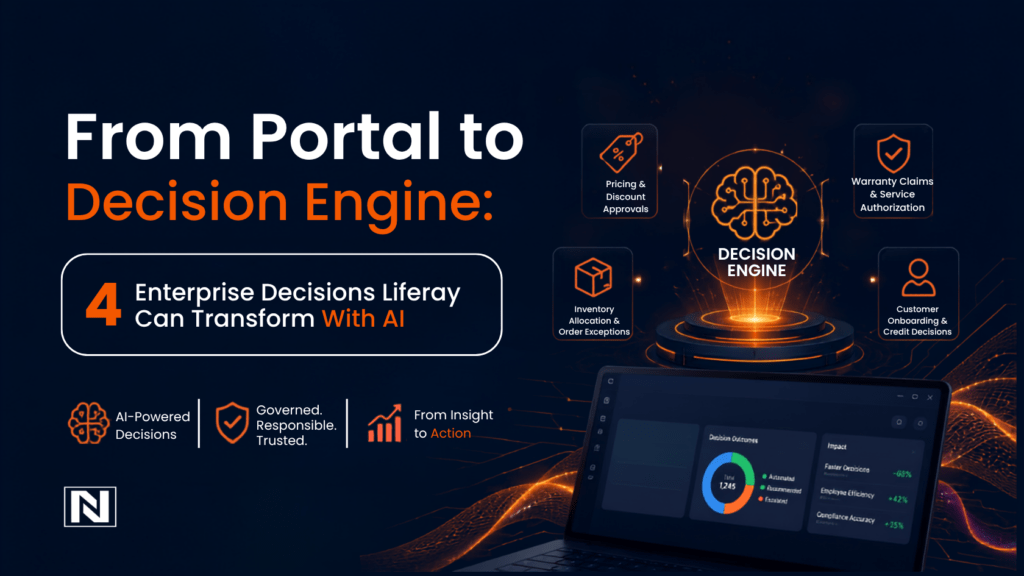
4 Enterprise Decisions Liferay Can Transform With AI
Pricing & Discount Approvals
A dealer requests a special discount. Instead of manually checking CRM history, ERP margins, inventory, contracts, and approval rules, an AI decision engine brings that context together.
Automate: Standard discounts within predefined boundaries.
Recommend: AI evaluates customer value, inventory, history, and contractual context and recommends an appropriate discount.
Escalate: High-value or unusual exceptions go to finance with the supporting evidence.
The AI doesn’t replace the pricing policy. It helps apply the policy intelligently.
Warranty Claims & Service Authorization
Warranty processors often have to check serial numbers, purchase dates, policy terms, technical documents, labor rates, parts, and previous claims. A Liferay AI workflow automation approach can divide the workload.
Automate: Routine claims that meet deterministic rules.
Recommend: AI identifies similar historical claims or interprets unstructured technical information.
Escalate: High-cost, unusual, or potentially fraudulent claims go to specialists.
Instead of simply showing a claim, the system can show: The claim. The relevant policy. Similar cases. The recommendation. And the reason. That is a fundamentally better employee experience.
Inventory Allocation & Order Exceptions
When inventory is constrained, “first come, first served” may not produce the best business outcome.
An AI-powered decision engine can consider:
- Contractual commitments
- Strategic customers
- Margin
- SLA penalties
- Warehouse availability
- Substitute SKUs
- Freight costs
It could recommend: Allocate 60% to Customer A because of its contractual SLA and source the remaining requirement from the secondary warehouse at an estimated 4% additional freight cost. The supply-chain manager makes the final call where the trade-off matters. AI does the heavy analysis.
Government Permitting & Eligibility
Government portals contain thousands of decisions around licensing, permitting, grants, eligibility, and compliance.
A Liferay DXP environment can provide the digital intake, forms, documents, identity, and workflow context. AI can interpret unstructured submissions. Rules can validate deterministic eligibility.
The decision engine can then:
Automate routine compliant applications.
Recommend actions for cases requiring interpretation.
Escalate high-risk or conflicting cases to specialists.
This is where AI governance becomes particularly important. The NIST AI Risk Management Framework provides useful guidance around trustworthy AI, governance, risk management, transparency, and accountability.
Our 180-Day Enterprise AI Playbook
We don’t recommend starting with: “Let’s build an enterprise AI platform.”
Start with: “Which decision is costing us the most time, money, or operational capacity?”
Months 1–2: Shadow Mode
Choose one high-volume, high-friction decision.
Look for one where:
- Data sits across multiple systems.
- Turnaround takes days rather than minutes.
- Financial or operational impact is measurable.
- The decision is reasonably repeatable.
Connect the necessary systems and run the AI decision engine in shadow mode. The system recommends. Humans continue deciding. Now you have evidence rather than assumptions.
Months 3–4: Hybrid Automation
Divide decisions into three categories:
Automate - low-risk, rule-based decisions.
Recommend - medium-risk decisions where AI provides context.
Escalate - high-risk decisions requiring human judgment.
This is also consistent with AWS guidance on moving generative AI from experimentation into governed enterprise production. See AWS Enterprise-Ready Generative AI Platform guidance.
Months 5–6: Measure Business Value
Don’t lead with model accuracy.
Measure:
- Decision turnaround time
- Manual effort
- Revenue recovered
- Margin preserved
- Fraud detected
- Customer waiting time
- Exception rates
- Human override rates
In one B2B manufacturing scenario, moving from manual multi-system review to a unified decision workflow reduced approval turnaround from 3–5 business days to under two hours.
The lesson was simple: Integration brought the information together. Intelligence made it actionable.
AI Should Not Make Every Decision
This distinction is critical. If the rule says: Discount above 15% requires CFO approval. You don’t need an LLM. That’s a business rule. AI is valuable where interpretation, probability, context, or unstructured information is involved.
Rules define the boundaries.
AI interprets the context.
Humans own consequential judgment.
Workflows execute the outcome.
That is the foundation of human-in-the-loop AI. Governance should also include permissions, audit trails, decision history, AI recommendations, human overrides, and appropriate data controls. The NIST AI RMF Playbook provides practical guidance on governance, human oversight, roles, and accountability.
Why Nirvana Lab Sees Liferay Differently
A traditional Liferay partner may focus on: Portals. UI. Content. Workflows. Upgrades. Integrations.
A pure AI consultancy may focus on: LLMs. Agents. Models. RAG. Chatbots.
Nirvana Lab operates between those worlds. We combine: Liferay DXP + Enterprise Integration + AI + Decision Governance.
We don’t build isolated portals. We don’t build isolated AI models. We engineer AI-ready digital experience ecosystems. Our objective is not another multi-year platform overhaul. It is to turn the systems an enterprise already owns into the decision platform it needs.
From Portal to Decision Engine
The first four articles established the journey:
DXP → Decision Platform
Data → Action
AI → Governed Intelligence
Pilot → Enterprise Roadmap
This final article brings the idea into real operational decisions. A dealer wants a faster pricing decision. A customer wants a warranty claim resolved. A supply-chain manager wants scarce inventory allocated intelligently. A government officer wants legitimate applications processed faster without compromising controls. Those are decisions.
And decisions are where digital transformation becomes measurable. We believe the next generation of Liferay isn’t about publishing content faster. It’s about executing enterprise decisions smarter. You don’t necessarily need to replace the systems you already own to become an AI-enabled enterprise. You need to make them smarter.
Frequently Asked Questions
What is Liferay AI?
Liferay AI is the use of artificial intelligence with Liferay DXP to improve digital experiences, workflows, information access, automation, and enterprise decision-making.
What is Liferay Decision Intelligence?
Liferay Decision Intelligence combines Liferay context with enterprise data, business rules, AI, workflows, and human judgment to determine whether a decision should be automated, recommended, or escalated.
Can Liferay integrate with ERP and CRM systems for AI?
Yes. Liferay’s APIs and headless capabilities allow it to interact with external enterprise systems. This makes it possible to combine Liferay context with ERP, CRM, document, and other enterprise data.
Does an enterprise need to replace Liferay to implement AI?
No. A better approach is often to add an intelligence and orchestration layer around the existing Liferay environment and start with one measurable business decision.
What decisions can Liferay and AI transform?
Common opportunities include pricing approvals, warranty claims, inventory allocation, order exceptions, customer service prioritization, compliance decisions, permitting, licensing, and eligibility workflows.
Should AI or business rules make enterprise decisions?
They have different roles. Rules establish hard boundaries; AI interprets context; humans retain accountability for consequential decisions.
How should an enterprise start with Liferay Decision Intelligence?
Start with one high-volume, high-friction decision. Run the system in shadow mode, introduce hybrid automation, measure business outcomes, and then scale to additional decisions.
How does AI governance apply to Liferay?
AI governance can include role-based access, approval thresholds, audit trails, decision history, AI recommendation logging, human overrides, data controls, and exception handling.
What is the biggest mistake enterprises make with Liferay AI?
Starting with the technology instead of the decision. Rather than asking “Where can we use AI?”, ask: “Which business decision should become faster, smarter, more consistent, and more explainable?”
About Nirvana Lab
Nirvana Lab helps enterprises modernize digital experience architecture and connect Liferay, enterprise systems, cloud infrastructure, AI, and intelligent automation into practical business solutions.
Our focus isn’t simply deploying another AI capability.
It’s helping organizations turn the technology they already own into a foundation for smarter, faster, and more governable enterprise decisions.