


Two weeks ago, we introduced the idea of Liferay as more than a presentation layer — a platform capable of becoming a genuine decision engine when paired with the right AI architecture. Last week, we extended that idea into a full framework: Build, Scale, Automate, and Decide, with one line doing a lot of the heavy lifting — the system identifies the pattern, the platform provides the context, and the employee makes the final call. That line is easy to write and hard to operationalize.
What does it actually mean for an AI recommendation, a business rule, and a human checkpoint to work together inside a live Liferay environment? This post unpacks the mechanics — and just as importantly, the governance model that makes a decision-intelligent Liferay platform trustworthy enough for regulated, high-stakes environments.
Why Liferay AI Governance Is the Missing Piece in Most AI Rollouts
Most enterprise AI initiatives stall not because the models are inaccurate, but because nobody can answer a simple question: why did the system recommend this? Without a clear governance model, AI recommendations inside a portal look like a black box, and black boxes don't survive contact with compliance, legal, or a skeptical department head.
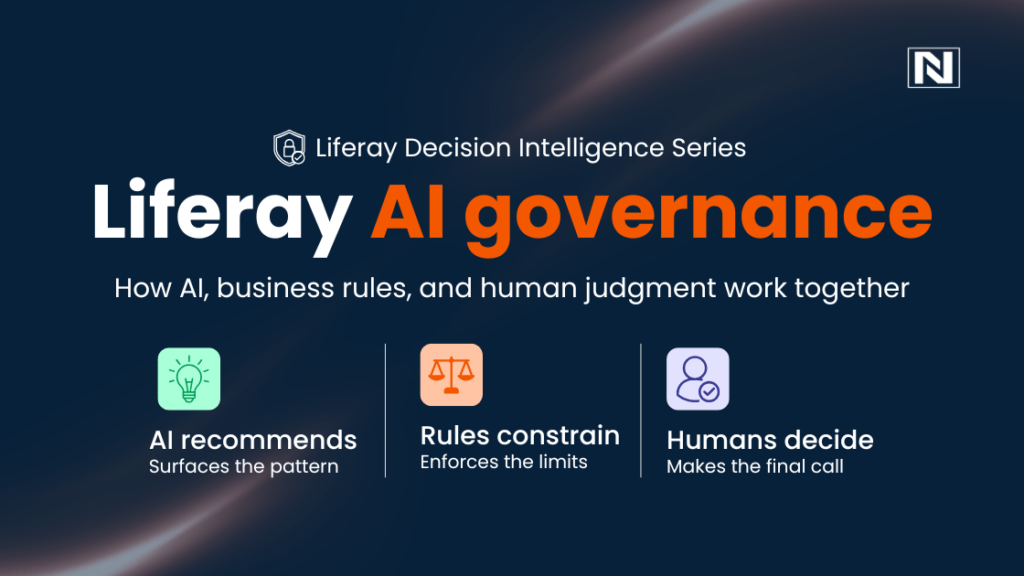
Liferay AI governance solves this by design, not as an afterthought. It treats every AI-influenced decision as a three-party negotiation between an intelligence layer, a rules layer, and a human layer — each with a defined role, and each auditable independently.
The Three-Layer Decision Engine Behind Liferay AI Governance
Think of a decision-intelligent Liferay platform as three layers stacked on top of the portal your users already know:
The AI layer surfaces patterns humans would miss at scale — a dealer whose reorder pattern signals churn risk, a support ticket whose phrasing matches twelve prior escalations, a supplier whose delivery variance is trending upward. This layer generates a recommendation, not a decision.
The business rules layer applies the constraints your organization has already agreed on — pricing floors, approval thresholds, regulatory limits, contractual terms. Rules don't learn or adapt; they enforce. This is deliberate. Rules are where an organization encodes what it will never allow an AI recommendation to override.
The human layer is the final checkpoint for anything above a defined risk or value threshold. Not every decision needs a human in the loop — that would defeat the purpose of automation — but every decision needs a human able to be in the loop, with full visibility into why the system suggested what it did.
This isn't a new concept in enterprise software. What's new is doing it natively inside the portal your employees, dealers, and partners already log into every day, rather than bolting on a separate decisioning tool nobody adopts.
Liferay AI Governance in Action: Two Worked Examples
Dealer Portal Pricing Decisions
Picture a manufacturer running a Liferay-based dealer portal. A regional dealer requests a volume discount outside the standard tier. The AI layer reviews the dealer's order history, payment reliability, and regional demand trends, and recommends an exception with a suggested margin. The business rules layer checks that recommendation against a hard floor — no exception may drop margin below a set percentage, regardless of what the model suggests. If the recommendation clears that floor, it routes to a sales manager with the underlying data attached: order history, the specific pattern that triggered the recommendation, and the rule check that passed. The manager approves, adjusts, or rejects — in seconds, not days, and never blind.
Partner Lead Routing
In a partner portal, incoming leads historically got routed by whoever happened to check the queue first — a slow, inconsistent process that frustrated high-performing partners. With a decision-intelligent layer, the AI ranks leads by conversion likelihood and matches them against partner specialization and current capacity. Business rules enforce fairness constraints — no partner can be starved of leads for more than a set period, regardless of the model's ranking. Partner managers see a dashboard, not a mystery: which lead, matched to which partner, on what basis, with an easy override.
In both cases, the pattern is the same: AI recommends, rules constrain, humans decide — and every step of that chain is visible after the fact, not just at the moment of decision.
Why Liferay AI Governance Needs Explainability and Audit Trails
For regulated industries — financial services, healthcare, government, higher education — governance isn't a nice-to-have layered on top of AI. It's the condition under which AI gets approved for use at all. Three elements matter most:
When a knowledge test was trying to solve a practice problem
In one IT services environment, the perceived problem was that experienced developers weren’t moving fast enough toward cloud-native development. The answer was a strict technical examination. It had a timer, proctoring and a pass mark. And it failed badly. A large majority of senior developers failed the first attempt. Cheating increased. Morale took a hit.
But the real discovery came later. The developers knew the theory. They simply didn’t have enough opportunity to practise in realistic environments because internal security restrictions limited access to suitable sandbox environments. The organization had been trying to fix a practice problem with a knowledge test. That was an expensive lesson.
- Explainability: Every recommendation should trace back to the specific data points that produced it. “The model suggested this” is not an answer a compliance officer will accept; “the model suggested this because of these three factors” is.
- Audit trails: Every decision — AI recommendation, rule check, human action — should be logged with a timestamp and an identity. This turns “we think this is what happened” into “here is exactly what happened,” which matters enormously the first time a decision gets questioned months later.
- Override visibility: When a human overrides an AI recommendation, that override itself is valuable data. Patterns in overrides often reveal where the model needs retraining, or where a business rule needs updating — governance done well makes the system smarter over time, not just safer.
The Architecture Behind Liferay AI Governance
None of this requires replacing Liferay or bolting on a disconnected AI product. As we outlined in our first post on Turning Liferay into a decision platform, the underlying architecture stays additive: Liferay continues to run the portal exactly as it does today, while an AWS-based layer — S3 for data staging, Bedrock or SageMaker for processing — handles the AI recommendation and rules evaluation, feeding results back into the portal experience your users already trust.
Governance sits inside that same architecture. Audit logs, explainability data, and override history live alongside the recommendation pipeline, not in a separate system that someone has to remember to check. This is the same phased, non-disruptive philosophy behind the Build, Scale, Automate, Decide framework
— governance is built in from the first pilot, not retrofitted after a scandal.
Building Liferay AI Governance Into Your Platform: Where to Start
Organizations don't need to design a perfect governance model before piloting their first use case. A few principles keep it manageable:
- Start with one decision type, not the whole portal. Pick a single recurring decision — pricing exceptions, lead routing, ticket escalation — and build the full AI-rules-human loop for that one case before expanding.
- Set the human threshold deliberately: Decide upfront which decisions are low-risk enough to automate fully, and which always require a human sign-off, based on financial impact, regulatory exposure, or reversibility.
- Log everything from day one: Retrofitting audit trails onto a system already in production is far harder than building them in from the pilot stage.
- Review overrides monthly: A recurring pattern in human overrides is a signal, not noise — it tells you where the model or the rules need adjustment.
What Comes Next
Governance is what makes a decision-intelligent Liferay platform trustworthy. The next question is practical: how does an organization actually get from where it is today — a portal generating data nobody uses — to a fully governed, decision-intelligent platform running across multiple domains? That's the roadmap we'll walk through next.
Frequently Asked Questions
What is Liferay AI governance?
Liferay AI governance is the set of controls — explainability, audit trails, business rules, and human checkpoints — that ensure AI-driven recommendations inside a Liferay portal remain transparent, compliant, and accountable, rather than operating as an unexplainable black box.
Does adding AI governance to Liferay require replacing the platform?
No. Governance is built into the same additive AWS-based architecture used for AI recommendations — Liferay continues operating unchanged while a parallel layer handles AI processing, rule enforcement, and audit logging.
How do business rules differ from AI recommendations in this model?
AI recommendations are probabilistic and adapt based on data patterns. Business rules are fixed constraints — such as pricing floors or approval thresholds — that the organization defines and that AI recommendations can never override.
Why do human overrides matter in a governed AI system?
Overrides are a feedback signal. Recurring override patterns often reveal where a model needs retraining or where a business rule is outdated, making the system more accurate over time rather than static.
Is this governance approach suitable for regulated industries?
Yes. The explainability, audit trail, and override visibility built into this model are specifically designed to meet the transparency and accountability standards required in financial services, healthcare, government, and higher education.
Ready to Build a Governed, Decision-Intelligent Liferay Platform?
Turning AI recommendations into decisions your organization can trust requires more than a model — it requires an architecture built for transparency from day one. Nirvana Lab helps enterprises design and implement AI-powered Liferay solutions with governance built in from the first pilot. Explore our Liferay AI integration and personalization services to see how we can help you get there.