For decades, enterprise assessment has been built around a deceptively simple equation: Response → Score → Decision.
It works—until the decision becomes important.
A candidate scores 82%. An employee passes a certification. A learner completes a course and scores 91% on the final assessment. The number is stored in an LMS, ATS or HRIS, and everyone moves on. But what does the number actually prove?
The enterprise assessment industry has become addicted to the illusion of precision through arbitrary numbers. We measure performance, compress it into a score, and then discard much of the evidence and context that explain why the score exists. A score without evidence is not capability intelligence. It is a summary. And increasingly, summaries are not enough.
The World Economic Forum’s Future of Jobs Report 2025 estimates that 39% of workers’ existing skill sets will be transformed or become outdated between 2025 and 2030. When capabilities are changing that quickly, enterprises need more than a static skills inventory. They need an architecture capable of continuously answering:
What can this person actually do? How strong is the evidence? How confident are we? And what should happen next? That is the real problem of enterprise skills intelligence.
Assessment should create evidence, not just scores
A traditional assessment pipeline looks like: Item → Response → Score → Report
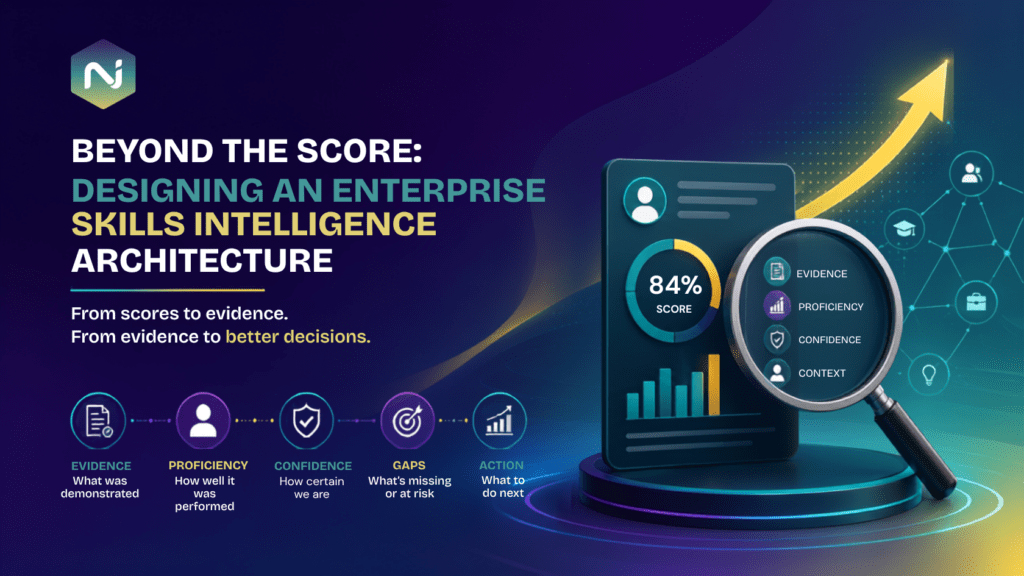
An enterprise skills intelligence architecture should look more like: Interaction → Evidence → Skill → Proficiency → Confidence → Capability Gap → Intervention → Reassessment
That difference is architectural. The original response should remain connected to its context: the assessment item and version, rubric, evaluator, assessment conditions, evidence used to reach the judgment and the resulting proficiency estimate. In other words, the assessment should create an evidence lineage. Imagine two employees both receive an 84%. One achieved 95% on theoretical knowledge but failed a critical security scenario.
The other demonstrated consistent performance across coding, problem-solving and applied judgment. Treating both as simply “84%” is convenient. It is not intelligent.
The Standards for Educational and Psychological Testing, developed by AERA, APA and NCME, place validity, reliability and appropriate interpretation at the center of responsible assessment. Enterprise assessment architecture should bring those principles into the data model—not leave them buried inside a psychometric report.
Skills taxonomy is not skills intelligence
There is another distinction enterprises need to make. A skills taxonomy organizes skills. A competency model describes broader combinations of knowledge, skills, behaviors and performance expectations. A skills graph connects people, skills, roles, competencies and other entities. But none of these, by themselves, proves that someone can perform. This is why the next generation of skills intelligence needs an explicit evidence layer.
Platforms such as Workday Skills Cloud have helped establish the importance of skills ontologies and skills-based workforce data. Research from IBM Research has also explored enterprise knowledge graphs for representing skills and expertise.
Meanwhile, TalentGuard emphasizes governed skills taxonomies, proficiency levels, role mapping and auditability. These are important developments. But the harder question is: What evidence makes a skill claim trustworthy?
That is where assessment becomes the measurement layer of skills intelligence. Instead of: Employee → Python the enterprise should be able to represent: Employee → Python → Level 3 → demonstrated through Assessment X → evidence Y → rubric Z → confidence C → last validated Date D
That is a very different kind of workforce data.
Every assessment item needs a purpose
One of the most overlooked problems in assessment design is weak assessment-item-to-skill mapping. If one question supposedly measures five competencies, what does an incorrect response actually tell us? Usually, not enough. A technically mature assessment data architecture should maintain explicit relationships between Item → Construct → Skill → Competency → Evidence
This creates item-level diagnosticity. An item should contribute meaningful evidence toward a defined capability. Its difficulty, discrimination, calibration history and performance should be monitored over time. This also prevents one of the most dangerous assessment failures: the masked failure. An employee may score 82% overall while falling below a minimum threshold in data privacy, safety or regulatory compliance. A weighted average calls that a pass. A capability intelligence system should recognize it as a material risk.
A score needs a confidence envelope
The difference between 74% and 76% may look meaningful. But if the measurement error is ±5%, the distinction may be meaningless. A mature assessment architecture therefore needs to associate a result with an evidence and confidence envelope.
At minimum, that envelope should consider:
- Diagnosticity- Did the assessment generate evidence that actually differentiates capability?
- Reliability- How much measurement uncertainty surrounds the result?
- Evaluation quality- How consistent and governed was the scoring process?
This becomes particularly important with open-ended assessments.
An architectural design, leadership simulation or situational judgment response cannot always be reduced to a simple right-or-wrong answer. Different evaluators may interpret the same evidence differently. The solution is not necessarily to remove humans. It is to make evaluation structured, calibrated and traceable.
Human evaluators need consistent rubrics and calibration. AI can assist by extracting evidence, identifying patterns and drafting evaluations—but the system should preserve the distinction between an AI recommendation and a human judgment.
The Society for Industrial and Organizational Psychology’s guidance on AI-based assessments makes an important point: AI-based employment assessments sho
Preserve lineage, not just history
There is an important difference between storing historical results and preserving assessment lineage. Suppose an organization changes its competency framework next year.
If all it retained was: Employee A → 82% → 2026 the employee probably has to be tested again.
But if the system preserved the original response, assessment item, rubric, evidence and evaluation context, portions of that evidence may be reusable against the new framework. Not every historical response will support every new capability claim. That limitation should be explicit.
But the architecture can determine what evidence remains relevant rather than assuming that every change requires a complete reset. This is why immutable evidence and versioned interpretation matter. The evidence can remain stable while the organizational framework evolves.
From skills database to capability risk engine
The ultimate purpose of skills intelligence is not a better dashboard. It is better business decision-making. Imagine an organization preparing a team to migrate a critical banking platform to microservices.
The question isn’t:
“How many employees completed microservices training?”
It is:
“Do we have enough demonstrated capability to execute this initiative safely?”
An enterprise capability architecture could connect: Business Objective → Required Competencies → Required Skills → Current Evidence → Confidence → Capability Gaps → Intervention → Readiness
The result might reveal that a team has strong general cloud knowledge but insufficient demonstrated capability in event-driven architecture. That gap can trigger a targeted learning intervention, simulation or coaching workflow.
Afterward, reassessment creates a new evidence point linked to the baseline. Now L&D can ask: Did demonstrated capability actually improve?
That is a far more meaningful question than: Did employees complete the course?
The market is already moving in this direction. Workera’s Skills Intelligence Engine, for example, emphasizes verified skills, calibrated assessments, evidence and continuous capability measurement. The opportunity now is to make the underlying assessment evidence layer portable, governed and reusable across the enterprise talent ecosystem.
The emerging enterprise skills graph
Eventually, assessment intelligence should not live inside an assessment platform. APIs should connect assessment data with the ATS, LMS/LXP, HRIS, talent marketplace and other workforce systems. The resulting enterprise skills graph could connect:
People ↔ Skills ↔ Competencies ↔ Roles ↔ Assessment Evidence ↔ Learning ↔ Work ↔ Outcomes
But there is a critical distinction. The most valuable object in that graph should not be the skill tag. It should be the evidence relationship.
That changes the graph from:
“Employee has cybersecurity.”
to:
“Employee demonstrated secure coding capability at Level 3 under defined conditions, supported by evidence X, evaluated against rubric Y, with confidence Z, last validated on Date D.”
That is much more useful for workforce planning, internal mobility, capability-gap analysis and L&D intervention mapping. It is also more honest.
AI should assist the judgment—not become the authority
The temptation is to make the entire assessment process autonomous. That is the wrong ambition. AI should reduce administrative friction and increase the amount of evidence humans can interpret. It should not manufacture algorithmic authority.
At NirvanaIntellect, the principle is simple: AI can assist judgment. It should not own judgment.
AI can:
- extract evidence;
- identify patterns;
- draft rubric evaluations;
- flag anomalies;
- recommend interventions;
- summarize longitudinal changes;
- and help map evidence to skills.
But high-stakes decisions should retain accountable human oversight. This is consistent with the NIST AI Risk Management Framework, which emphasizes trustworthy AI characteristics including validity, reliability, transparency, explainability, privacy and fairness, as well as defined human oversight.
For employment applications, the U.S. Equal Employment Opportunity Commission also emphasizes that employment tests and selection procedures need to be appropriately validated for their intended purpose. The architecture should therefore make human accountability visible in the data, not merely mention it in a governance policy.
The real shift: from scores to governed evidence
The future of enterprise assessment will not be won by whoever produces the most sophisticated dashboard. It will be won by whoever can answer, with confidence:
What can this person actually do?
What evidence supports that conclusion?
How reliable is that evidence?
How relevant is it to the role?
How has that capability changed?
What should the organization do next?
And, when challenged: Can we reconstruct how we arrived at this decision?
That is the difference between an exam platform and capability intelligence infrastructure. The architectural opportunity behind NirvanaIntellect is not simply to make assessment software smarter. It is to make assessment data persistent, contextual, measurable, interoperable and accountable—so that every assessment becomes another piece of organizational intelligence rather than another isolated score. Because a score tells you what happened. Evidence tells you why. And capability intelligence tells you what to do next.
Frequently Asked Questions
What is enterprise skills intelligence?
Enterprise skills intelligence is the structured use of skills, competency, assessment and workforce data to understand what people can actually do, how strongly they can do it, where capability gaps exist and how those capabilities change over time.
How is skills intelligence different from a skills taxonomy?
A skills taxonomy organizes and classifies skills. Skills intelligence adds evidence, proficiency, context, confidence, recency and relationships to roles and business requirements. A taxonomy tells you what skills exist; skills intelligence helps determine which skills are actually demonstrated.
Why is assessment evidence more valuable than a score?
A score is an aggregate representation of performance. Evidence provides the underlying explanation: which responses or behaviors supported the result, what was evaluated, under which rubric and with what level of confidence.
What is assessment lineage?
Assessment lineage is the trace connecting an assessment result back to its underlying response, item, rubric, evaluator, evidence, interpretation and subsequent reassessment. It makes assessment data more auditable and reusable.
Can AI evaluate employee assessments?
AI can assist with evidence extraction, pattern recognition and draft scoring. For high-stakes employment decisions, organizations should retain appropriate human oversight, validation and accountability rather than treating AI output as an unquestionable decision.
What is an enterprise skills graph?
An enterprise skills graph connects people, skills, competencies, roles, assessments, evidence, learning and work opportunities. Its value increases when skill relationships are supported by verified evidence rather than relying solely on self-reported or inferred skills.
Can assessment intelligence measure L&D ROI?
It can provide a stronger basis for measuring capability change. By connecting pre-intervention evidence with post-intervention reassessment, organizations can evaluate whether demonstrated capability improved rather than relying only on course completion, learner satisfaction or post-course quiz scores.