The Hidden Cost of "Good Enough" SEO
Picture this: your team just launched a new product category. The campaign is live, the ads are running, and the landing page looks great. Then someone asks the question that nobody wants to answer - "Did we actually set up the SEO?"
A brief silence. Someone opens a browser tab to check. Then another tab. Then a third. The meta title is somewhere in Web Content Viewer. The sitemap lives in System Settings. The friendly URL for the new category was handled by a developer three months ago, and nobody wrote it down. The Open Graph tags for the blog? They might exist. Hopefully.
If you work in a Liferay marketing team, that scene will feel familiar. And here is the thing - it is not your team's fault, and it is not Liferay's fault either. Liferay is a genuinely powerful DXP. But its SEO capabilities were built to fit the architecture of the platform, not the workflow of a marketer. The result: every SEO task lives in a different corner of the system, depending on what type of content you are managing. This is exactly the gap that the Marketing Accelerator - Liferay DXP SEO Tool is designed to close.
For small sites with a full-time technical team on hand, this is manageable. For growing businesses with multilingual content, active commerce catalogues, and a marketing team that cannot wait two days for a developer ticket - it is a slow, quiet drain on organic performance that gets worse the bigger you get.
CASE STUDY
A Story You Might Recognise - A Leading Home Furnishings Retailer
[Company name withheld under NDA] - referred to here as "the Client" - is a mid-size home furnishings retailer with storefronts in India, Mexico, and Singapore. They run a Liferay Commerce-powered site with around 4,200 product SKUs, a regularly updated blog, localised landing pages for each market, and a shared asset library across their regional sites.
Their marketing team of five covers SEO, content, and paid campaigns. They have one Liferay-certified developer available for roughly ten hours a week - a common setup for businesses of this size.
What was going wrong
Amanda Smith, the Client's SEO lead, had spent the better part of three quarters watching organic traffic flatline. The content calendar was full, new product pages were going live every week, and the team was doing everything right on paper. But the numbers refused to move.
She finally commissioned a third-party SEO audit. The results were uncomfortable to read. Over 40% of product pages had duplicate or missing meta descriptions. Dozens of blog posts had no canonical URLs configured. The XML sitemap had not been refreshed in four months, which meant Google was essentially in the dark about nearly 600 pages that had been added or updated since then.
The Spanish-language site targeting Mexico was the hardest finding. Those pages were practically invisible to regional search engines - missing hreflang tags, no locale-specific Open Graph metadata, and default English fallback content showing up when anyone shared a product link on social media. All that effort building a localised catalogue, and search engines could not properly index a single page of it.
The four pain points
- No Audit Visibility – No single place to see the SEO health of the entire site. Amanda Smith had to manually check individual pages to spot problems.
- Scattered Meta Management – Product meta in Commerce. Blog meta in the Blogs editor. Web Content meta in a different editor entirely. Each required a different navigation path.
- Developer Dependency – Friendly URLs, sitemap refreshes, and display page mapping all required developer access. A 2–day wait for a simple URL change.
- Multilingual Gaps – Spanish (Mexico) and Malay pages had no hreflang tags and no locale–specific Open Graph data – nearly invisible to regional search and social sharing.
When Amanda Smith mapped out where the team’s time was actually going, the picture was stark. Nearly 12 hours a week was disappearing into tool–switching, ticket–waiting, and manual page–by–page checking. That is almost a third of a full working week spent navigating the platform rather than doing SEO.
"We knew Liferay had the power. We just couldn't reach all the controls from the same room."
Amanda Smith, SEO Lead, [Client name withheld under NDA] (composite)
How Marketing Accelerator - The Liferay DXP SEO Tool - Changed the Picture
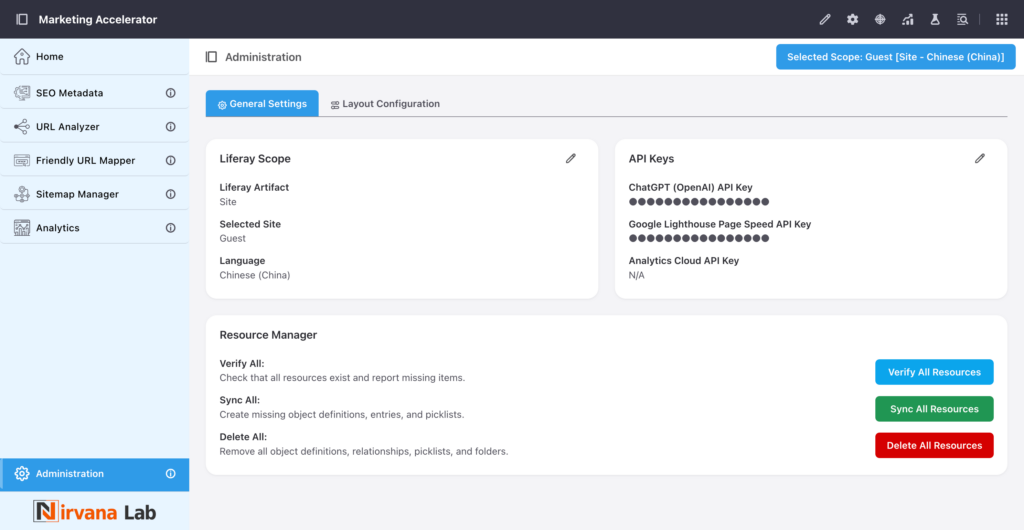
The Client's Liferay implementation partner introduced them to Marketing Accelerator by Nirvana Lab - the Liferay DXP SEO Tool that installs directly on top of an existing Liferay setup and brings every SEO and marketing workflow into one place. No migration, no data restructuring, no disruption to what is already working. It simply makes everything that was already in Liferay accessible from a single, marketer-friendly interface. Learn more on our Marketing Accelerator page.
The onboarding took one afternoon. Here is how it addressed each of the Client's problems in practice.

Problem 1 - No visibility across the site
Without a centralised view, Amanda Smith had no way of knowing the scale of the problem until she paid for an external audit. By then, months of indexing opportunity had already been lost.
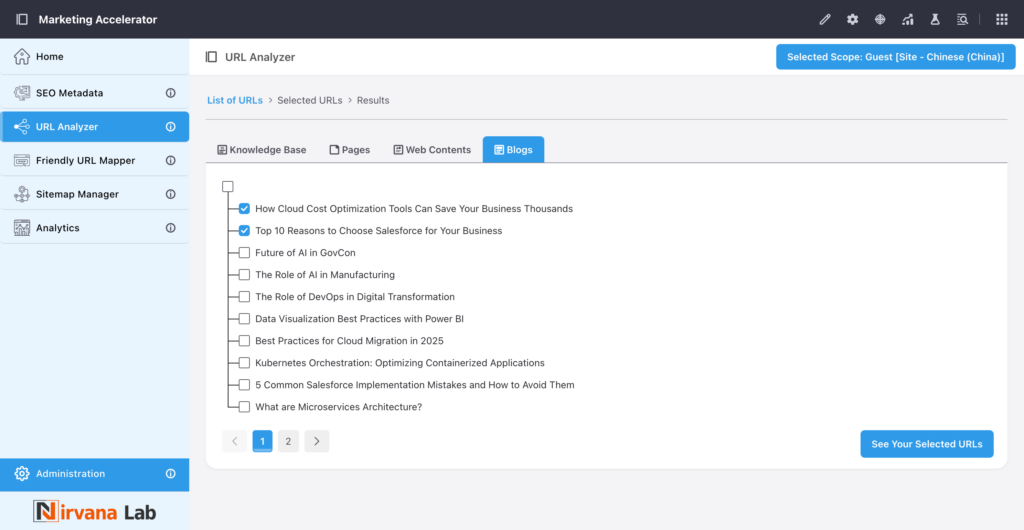
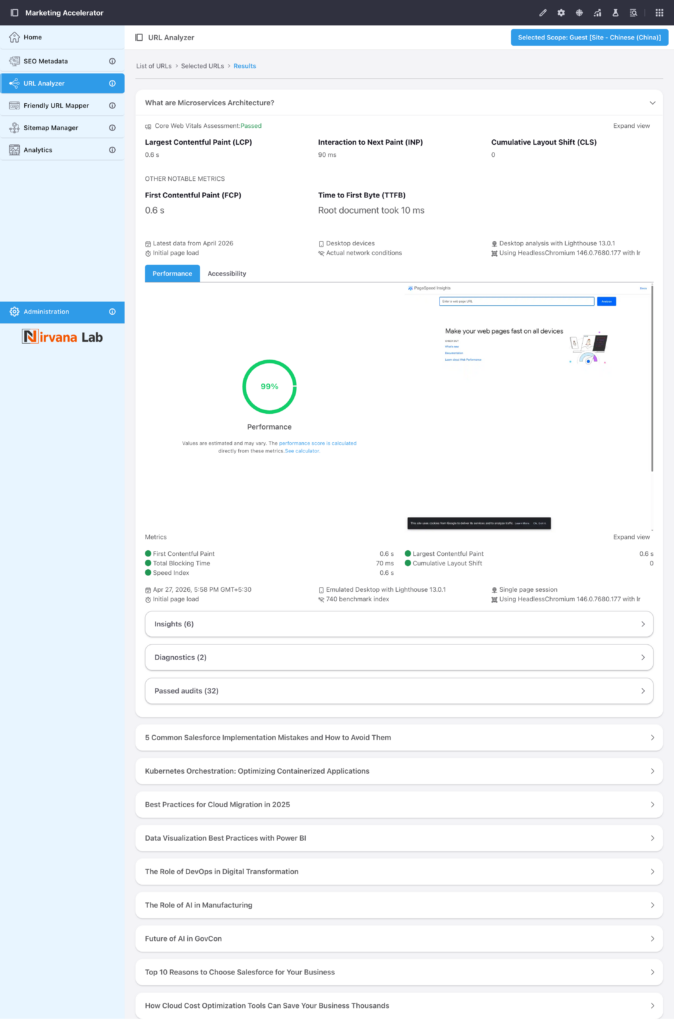
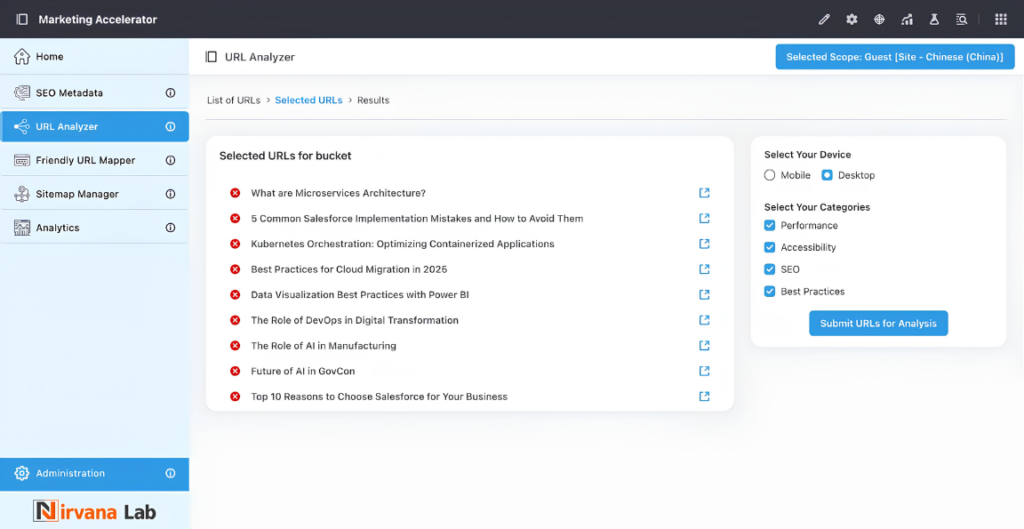
Resolution - URL Analyzer & SEO Health Dashboard: Within 20 minutes of setup, Marketing Accelerator's URL Analyzer - a core feature of this Liferay SEO plugin - had scanned the full Commerce catalogue and surfaced 214 pages with SEO issues, grouped by type, filterable by site and language, with clear next steps for each. No external tool, no third-party account, no waiting. Amanda Smith finally had the visibility she had been missing for months.
Problem 2 - Meta editing scattered across five different editors
Product metadata in the Commerce admin. Blog metadata inside the Blogs portlet. Web content in a completely different editor. Page metadata somewhere else. Each interface has its own navigation path, its own quirks, and its own depth of configuration options. Context-switching this frequently is not just inefficient - it is where mistakes happen.
Resolution - SEO Metadata Configurator: One screen. All content types. This Enterprise SEO for Liferay DXP capability meant Amanda Smith's team could now manage meta titles, descriptions, canonical URLs, robots directives, Open Graph tags, and Schema markup from a single unified interface. Bulk editing across product categories became a straightforward task, and switching between the English, Spanish, and Malay variants of the same page took seconds instead of requiring separate login sessions.

Problem 3 - A developer required for URLs and sitemaps
Every time a category was reorganised or a new landing page launched, a ticket had to go to the developer queue. Average wait: two days. And the sitemap - the document that tells Google what exists on the site - had been static for four months simply because nobody had escalated it as urgent.
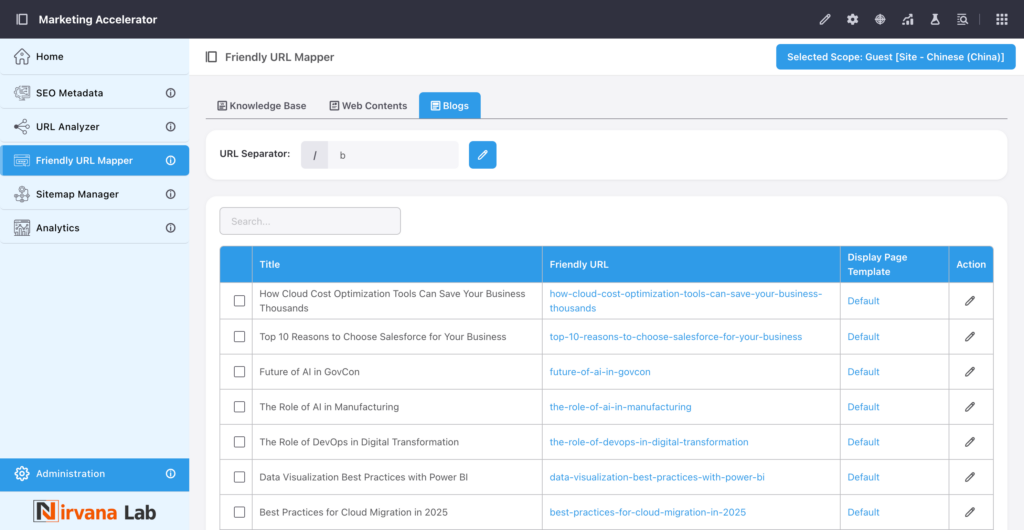
Resolution - Liferay Friendly URL Mapper + Liferay Sitemap Manager: The Liferay friendly URL mapper and Liferay sitemap manager features gave the team back control of their own URL structures. They could define Commerce category paths, visually map display page templates to content types, and - critically - trigger an on-demand sitemap refresh without raising a single ticket. The stale four-month-old sitemap was replaced with a complete and accurate one in under ten minutes. The developer queue shrank noticeably within the first week.

Problem 4 - The multilingual SEO blind spot
The Client had invested significantly in building their Spanish (Mexico) and Malay catalogue. But without correct hreflang signals and locale-specific Open Graph tags, search engines had no reliable way to surface those pages to the right audiences - and social shares in Mexico were defaulting to English preview content.
Resolution - Multilingual Metadata Editing: Marketing Accelerator handles locale-aware metadata editing natively. The team worked through the entire Spanish (Mexico) and Malay page set in a single afternoon - no template code, no developer involvement. Within weeks, those pages were appearing in regional search results with the correct language previews for the first time.
Ninety Days Later
The changes were not overnight magic. SEO rarely is. But the compounding effect of fixing hundreds of metadata gaps, refreshing the sitemap, and giving regional pages their proper signals started to show in the numbers within weeks. By the 90-day mark, the results were clear.
MEASURED OUTCOMES - [CLIENT NAME WITHHELD UNDER NDA] (90 DAYS POST-DEPLOYMENT)
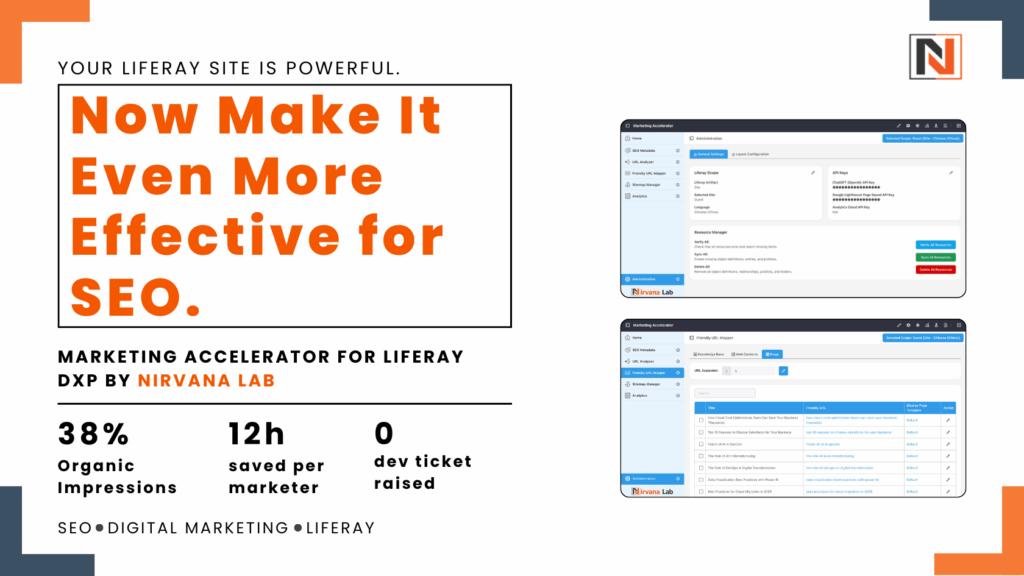
38% increase in organic impressions across all three sites
12 hours weekly SEO admin time saved per marketer
0 developer tickets raised for routine SEO tasks
The Mexican Spanish site was the standout. Organic traffic climbed 52% within 60 days - directly linked to correct Open Graph tags and populated meta descriptions finally appearing in Mexican regional search results. The content had always been good. It just needed to be findable.
Perhaps as importantly, the team dynamic shifted. The developer stopped fielding SEO tickets entirely. Amanda Smith's team stopped feeling like they needed permission to do their own jobs. That kind of confidence - knowing you have the tools to act without waiting - changes how a marketing team operates.
What Marketing Accelerator - Your Liferay DXP SEO Tool - Actually Gives You
The Client's story is one version of what this add-on solves. Here is the complete picture of what it brings to any Liferay installation, regardless of size or industry. You can also register for a live demo event to see it in action on a real Liferay instance.
THE FULL FEATURE SET

- SEO Metadata Configurator – Manage meta titles, descriptions, canonical URLs, robots directives, Open Graph tags, and Schema markup across all content types and locales in one interface. No more jumping between editors. The core of Enterprise SEO for Liferay DXP.
- URL Analyzer – This built–in Liferay SEO plugin scans the entire site for SEO issues, broken links, and URL duplicates. Delivers prioritised, actionable findings inside Liferay – no external tools or subscriptions needed.
- Liferay Friendly URL Mapper – Configure URL structures for any content type and visually map display page templates, without touching system settings or waiting on a developer.
- Liferay Sitemap Manager for SEO – Generate and manage XML sitemaps, control exactly which content is included, and trigger on–demand refreshes directly from the marketing interface.
- Analytics Overview – Surface key performance metrics at a glance, with quick access to deeper reports – so marketing teams stay informed without platform–switching.
- Cross–site & Commerce Support – Works across Sites, Asset Libraries, and Commerce Channels. Purpose–built for organisations managing multiple brands, regions, or storefronts from one Liferay instance.
Who This Is Really For
Marketing Accelerator is not designed for the developer who already knows where every system setting lives. It is built for the marketing team who should never have to know in the first place.
It is for the SEO lead managing content across five regional sites who needs to run a full metadata audit without involving engineering. It is for the content strategist who has a canonical URL to fix today - not in three days when a ticket gets picked up. It is for the e-commerce manager launching a seasonal category on Monday who wants to confirm the page is indexed and the meta is set before the campaign budget starts spending.
It is also, frankly, for the developer. Every hour they are not fixing a sitemap or updating a friendly URL is an hour available for the work that actually needs their skills. Marketing Accelerator is as much a gift to the technical team as it is to marketing.
The value scales with complexity. For a single-language site with a small catalogue, the time savings are real but modest. For organisations running multilingual storefronts across multiple brands and regions - the kind of organisations Liferay Commerce was built for - the return on a Marketing Accelerator deployment is immediate and compounding.
The Bottom Line
The decision to run on Liferay is usually a significant one - chosen for its depth, its flexibility, and its ability to scale. That investment deserves to perform. And right now, for too many Liferay teams, it is not performing at its SEO potential - not because Liferay is lacking, but because the interface between the platform and the marketing team has a gap in it.Marketing Accelerator - the Liferay DXP SEO Tool built by Nirvana Lab - fills that gap. It does not replace anything that Liferay does. It makes everything Liferay already does accessible to the people who need it most, in one place, without a support ticket and without a waiting queue.
If your Liferay site runs more than a few hundred pages, serves content in more than one language, or powers an active commerce catalogue - the real question is not whether Marketing Accelerator would add value. It is how much organic traffic and how many hours of team time you are leaving on the table every week without it. Visit the Marketing Accelerator page or register
for the next live event to get started.
Frequently Asked Questions
What exactly is Marketing Accelerator, and how does it fit into Liferay DXP?
Marketing Accelerator is a Liferay DXP add–on built by Nirvana Lab. It installs directly on top of your existing Liferay instance and brings all SEO and marketing–related workflows – metadata management, URL configuration, sitemap generation, and analytics – into a single, marketer–friendly control panel. It does not replace or modify anything native to Liferay; it makes what is already there accessible without requiring developer involvement for every task.
Do we need to migrate our existing content or restructure our Liferay setup?
No migration, no restructuring, and no disruption to existing content. Marketing Accelerator reads and writes through Liferay’s native APIs, so your pages, products, blogs, and web content continue to live exactly where they are. Onboarding typically takes one afternoon – configuration, not implementation.
Which versions of Liferay DXP does Marketing Accelerator support?
Marketing Accelerator is built for Liferay DXP and Liferay Commerce environments. For version–specific compatibility details and the latest release notes, visit the Marketing Accelerator page at thenirvanalab.com or contact the Nirvana Lab team directly. They can confirm compatibility with your specific Liferay version and stack before you commit.
Can non-technical marketing team members use it without developer help?
That is precisely what it is designed for. SEO metadata editing, URL configuration, sitemap generation, and PageSpeed audits are all accessible through an interface built around marketing workflows – not system administration. Routine SEO tasks that previously required a developer ticket can be completed directly by the marketing team. The developer queue shrinks; the marketing team gains autonomy.
Does it work for multilingual and multi-site Liferay setups?
Yes – and this is one of its strongest use cases. Marketing Accelerator supports locale–aware metadata editing, hreflang configuration, and locale–specific Open Graph tags across multiple languages and sites from a single interface. It also works across Liferay Sites, Asset Libraries, and Commerce Channels, making it well–suited for organisations managing multiple brands, regional storefronts, or language variants from one Liferay instance.
What SEO tasks can the tool handle that Liferay cannot do natively out of the box?
Liferay does support SEO configuration natively, but the controls are distributed across multiple editors depending on content type. Marketing Accelerator brings all of them – meta titles, descriptions, canonical URLs, robots directives, Open Graph tags, Schema markup, hreflang – into a unified interface. It also adds a built–in URL Analyzer for site–wide SEO auditing, an on–demand sitemap generator with advanced inclusion controls, and direct PageSpeed Insights integration – none of which are part of the standard Liferay DXP interface.
How quickly can we expect to see SEO results after deployment?
The speed of results depends on your site’s existing state and how many issues are corrected at deployment. In the case study featured in this blog, meaningful organic traffic improvements appeared within 60 days for the regional site, with a 38% increase in impressions across all sites by the 90–day mark. SEO is not instant, but fixing hundreds of metadata gaps, refreshing a stale sitemap, and correcting hreflang signals creates a compounding effect that accelerates indexing and improves rankings over time.
Where can we see Marketing Accelerator in action before committing?
Nirvana Lab runs regular live demo events specifically for Liferay teams. You can register at thenirvanalab.com/event/marketing–accelerator–for–liferay–dxp/ to see the tool running on a real Liferay instance. The Marketing Accelerator product page at thenirvanalab.com/marketing–accelerator/ has further details on features, supported versions, and how to get started.