

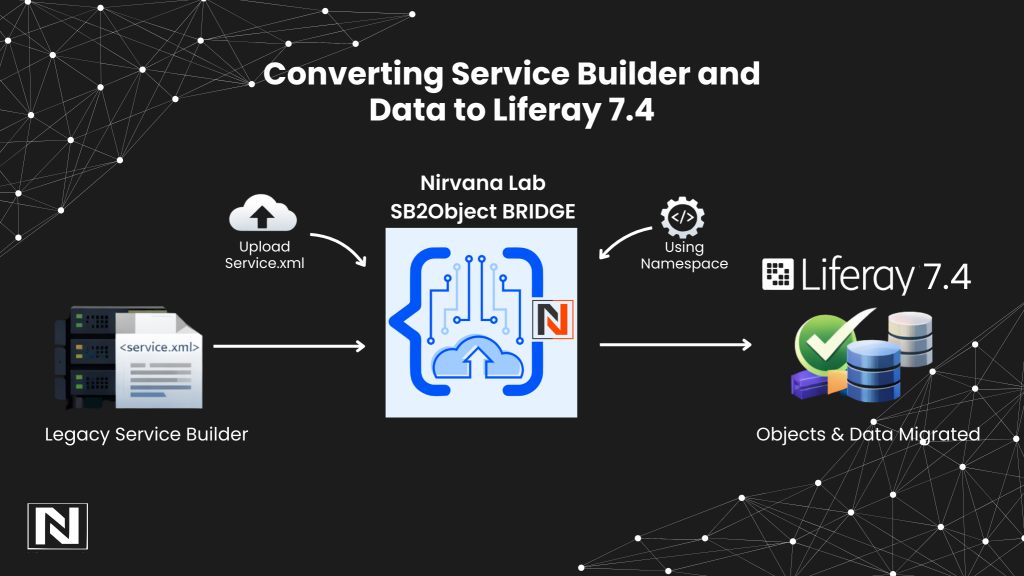
Introduction
Many organizations that use Liferay today are operating on a hybrid reality: they run mature, business-critical applications built years ago with Service Builder, while at the same time facing pressure to deliver faster, adapt quickly, and reduce long-term maintenance cost. This is especially common in enterprises and public-sector institutions where systems have grown over multiple release cycles, teams, vendors, and policy changes.
In this context, modernization is not about replacing everything overnight. It is about preserving what works, reducing what slows you down, and creating a practical path toward more agile data and application management.
That is why migration from Service Builder-driven data models to Liferay Objects has become a strategic topic. Liferay Objects enable a more flexible, metadata-driven model for many business domains. But moving safely from legacy structures to modern objects is not trivial. Teams need governance, repeatable workflows, and clear visibility into what is being created, migrated, validated, and finalized.
This is exactly where SB2Object Bridge Basic becomes valuable. It helps organizations bridge existing Service Builder assets into Liferay Objects with controlled execution and reduced operational risk. This blog explains the business and technical case for that transition, what each model offers, where the constraints are, how the utility works, and why it can materially improve modernization outcomes.
What is Service Builder?
Service Builder is Liferay’s traditional code-first framework for defining domain entities and generating the backend service and persistence layers. Developers define models in service.xml, and the platform generates model classes, services, finder logic, and supporting persistence infrastructure.
For many years, Service Builder has been the right answer for high-control enterprise development. It is powerful, proven, and aligned with rigorous software engineering practices.
Typical strengths include:
- Strong backend control for complex domain logic
- Predictable Java-centric architecture patterns
- Mature support for transactional services and custom behavior
- Versioned, code-reviewed lifecycle in CI/CD pipelines
- Stability for long-running core business applications
Many large Liferay deployments still depend heavily on Service Builder modules because they were designed for durability and strict control. In short: Service Builder has been foundational for custom enterprise applications and remains important in many architectures.
Service Builder limitations in modern delivery models
Even though Service Builder is powerful, it can become expensive for high-change business scenarios. The issue is rarely raw capability; the issue is change economics.
Slow turnaround for data model changes
If a business team needs a new field, relationship tweak, or model adjustment, the path often involves:
- Development update
- Build and packaging
- Test cycle
- Deployment coordination
- Regression checks
For fast-moving business domains, this is heavy.
High dependency on specialized developers
Routine model evolution often remains locked behind backend engineering availability. This can create bottlenecks and delay business outcomes.
Rising maintenance burden over time
As custom modules expand, upgrade effort, compatibility handling, and operational support become more demanding. Teams spend more effort sustaining legacy complexity.
Reduced agility for distributed teams
When multiple business units need frequent updates, centralized code ownership can slow delivery and increase prioritization conflicts.
Legacy schema complexity
Older modules may contain historical fields, naming inconsistencies, and technical artifacts that make modernization difficult without structured migration support.
So the limitation is not that Service Builder “cannot do it.” The limitation is that for many evolving business domains, it is no longer the most efficient operating model.
What are Liferay Objects?
Liferay Objects are metadata-driven custom business entities managed through platform capabilities and APIs. Instead of generating full backend code for every structural change, teams can define object models in a more configuration-oriented way, with governance and extensibility.
Objects typically support:
- Business entity definitions
- Custom fields and data structures
- Relationships and constraints
- API-based interaction patterns
- Better alignment with modern platform workflows
This model helps organizations shift from “code-first for every change” to “fit-for-purpose architecture,” where deeply custom logic remains coded, but high-change business entities can be managed more flexibly.
Benefits of Liferay Objects for business and technical teams
Faster business adaptation
Object-based models allow many structural updates to move faster than traditional backend release cycles. That reduces lead time for business requests.
Better cross-functional ownership
Developers, platform admins, and product teams can collaborate more effectively when every model update does not require deep backend refactoring.
Lower custom-code footprint
Reducing unnecessary custom code lowers long-term maintenance burden and improves upgrade posture.
Stronger modernization alignment
Organizations pursuing digital transformation need speed with governance. Liferay Objects help deliver that balance for many use cases.
Scalable delivery operating model
As programs scale across departments, object-driven approaches help standardize how teams evolve business data capabilities.
That said, Liferay Objects are not a universal replacement for every Service Builder module. Some highly specialized and transaction-heavy domains still belong in code-first architecture. The right approach is selective modernization, not blanket replacement.
What is SB2Object Bridge Basic utility?
SB2Object Bridge Basic is a migration utility built to help organizations transition from Service Builder-based models to Liferay Objects in a controlled and repeatable way.
At a practical level, it provides:
- A migration UI experience for analyzing and selecting entities
- REST-backed migration orchestration
- Structured workflows for object setup and data movement
- Safeguards around existing entities and action decisions
- Progress/status visibility to support operational control
Instead of relying on one-off scripts and manual interpretation, teams can use a guided utility approach that improves consistency and reduces migration uncertainty.
How this utility helps convert Service Builder to Liferay Objects and migrate data
The value of the utility is not just “moving records.” It supports end-to-end migration workflow with operational guardrails. Below is the graphical representation of how it works:
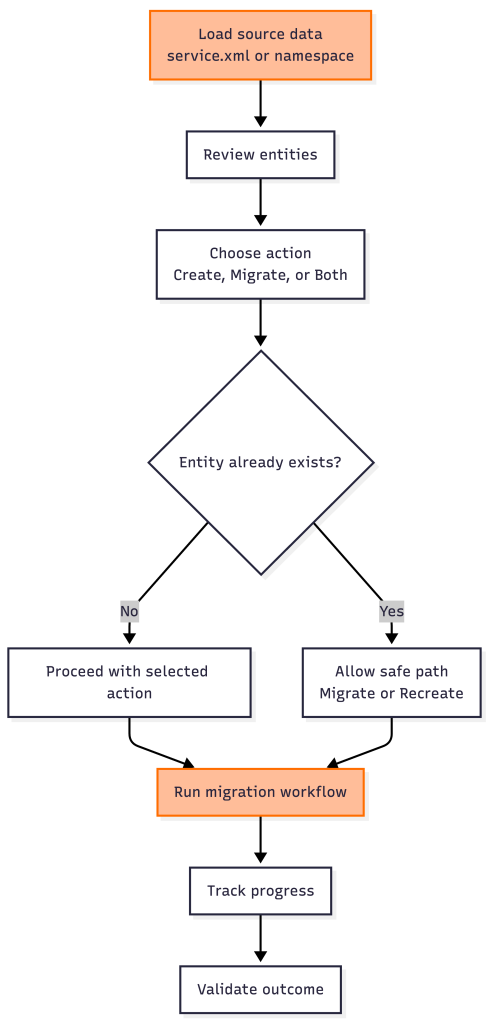
Source intake and discovery
Teams begin by loading source metadata (for example, Service Builder definitions or namespace-driven schema information). The utility extracts and presents entities and fields for review.
Entity-level analysis and selection
Not all entities should be migrated in the same way. The utility supports selection and action planning at the entity level so teams can phase work safely.
Controlled action mode
Teams can run:
- Create-only (prepare object structures)
- Migrate-only (data movement where structures exist)
- Create + migrate (combined flow where appropriate)
This flexibility is important for phased implementation and governance checkpoints.
Existing-object awareness and safety behavior
When target objects already exist, the workflow guides next steps so teams do not accidentally overwrite or misalign data models.
Structured object setup
Object definitions and fields are created in sequence, reducing manual setup mistakes and improving consistency.
Data migration orchestration
Data movement is executed through migration jobs with batch-oriented operational handling, rather than ad hoc manual SQL/processes.
Progress tracking and validation
Status and progress visibility helps teams monitor execution, identify failures, and confirm outcomes before formal handover.
In short, the utility turns migration from a fragile project activity into a manageable operational process.
Nirvana Lab SB2Object Bridge (Advance)
BUSINESS_OVERVIEW_V2.0
Executive Summary
Nirvana Lab SB2Object Bridge (Advance) v2.0 is a modernization accelerator for moving from legacy Service Builder models to Liferay Objects with stronger support for relationship-aware migrations and bidirectional sync automation.
v2.0 extends the platform from entity-only migration to relationship-driven object creation and data movement, while adding object-action automation to keep Object and Service Builder data in sync.
What Is New in v2.0
The following are new capabilities introduced in v2.0:
- Create Objects with Relationships: Automatically creates object relationships (1-N and N-N) as part of object model generation.
- Migrate Records with Relationships: Migrates records while preserving relationship mappings across parent-child and many-to-many structures.
- Object Action Auto-Creation for Sync: Automatically creates object actions to sync data from Object to Service Builder.
Business Outcomes
- Faster migration for domains with complex relational structures.
- Reduced manual relationship configuration after object creation.
- Improved data consistency through relationship-aware migration execution.
- Lower operational effort by automating Object -> Service Builder synchronization.
- Better confidence for phased cutovers with relationship and sync continuity.
End-to-End Business Flow (v2.0)
- Discover source structures through `service.xml` upload or namespace lookup.
- Detect entities and relationships from source metadata.
- Configure field options (required, unique, searchable, character limits) and execution scope.
- Create objects and relationships in Liferay.
- Migrate records including relationship links.
- Auto-create object actions for Object -> Service Builder synchronization.
- Monitor job progress and completion/failure states.
Capability Coverage
- Dual source intake: file upload and runtime namespace lookup.
- Entity and relationship discovery from Service Builder metadata.
- Object folder, definition, and field creation with type mapping.
- Relationship-aware object model generation.
- Relationship-aware data migration (including join-table semantics where applicable).
- Per-entity and bulk execution patterns.
- Existing object detection and ownership-aware behavior.
- User confirmations before impactful operations.
- Progress monitoring with completed/failed/pending visibility.
- Website notifications for terminal migration outcomes.
- Automatic Object Action creation for Object -> Service Builder sync.
Operational Controls
- Authenticated access only (guest blocked).
- Input validation and table-name guardrails.
- Explicit confirmation for create/migrate operations.
- Status visibility for jobs and migration progress.
Scope Notes
- v2.0 introduces relationship creation and relationship record migration as first-class capabilities.
- v2.0 introduces object-action generation for Object -> Service Builder synchronization.
- Legacy custom business logic still requires domain-specific redesign where needed.
Business Value Summary
v2.0 expands the product from structural conversion to relationship-aware modernization with synchronization automation. This improves migration completeness, lowers manual effort, and supports safer production adoption for Service Builder to Object transformation programs.
Why this utility is important for business programs
For executive stakeholders, the real question is: does this reduce risk and improve outcomes? With the right governance, the answer is yes.
Shorter time-to-modernization
Organizations can move from legacy custom models to modern object-based operation faster without rewriting entire systems.
Lower migration risk
Guardrails, staged actions, and status tracking reduce the chance of uncontrolled execution.
Better planning confidence
Program managers gain clearer checkpoints, better execution visibility, and more predictable wave-based rollout.
Improved stakeholder trust
Business owners can see migration progress and outcomes rather than relying on opaque backend processes.
Stronger value realization
Modernization benefits arrive sooner when teams can migrate incrementally and safely instead of waiting for large, disruptive releases.
Why this utility is important for technical teams
Repeatability over one-off effort
Instead of building custom scripts for each module, teams follow a reusable migration pattern.
Cleaner architecture evolution
Core domains that need deep code-level control can remain in Service Builder while high-change entities move to objects.
Better operational observability
Progress/status handling enables more disciplined operations during migration windows.
Reduced technical debt growth
As object-friendly domains move out of heavy custom layers, engineering teams can focus on higher-value logic.
Smoother collaboration
Developers, architects, admins, and QA can align around a shared migration workflow.
Practical migration strategy: how organizations should adopt it
A successful migration program is phased and outcome-driven.
Phase 1: Portfolio assessment
Classify Service Builder entities:
- Keep in Service Builder (highly custom, stable, complex logic)
- Migrate to Objects (high-change business entities)
- Hybrid candidates (require staged redesign)
Phase 2: Pilot with measurable goals
Run a contained pilot with explicit success criteria:
- Structural accuracy
- Data correctness
- Execution stability
- Recovery handling
- Stakeholder sign-off
Phase 3: Standardize governance
Define naming standards, mapping rules, validation checklists, and ownership boundaries before scaling.
Phase 4: Scale in waves
Expand migration by module/domain in prioritized waves, with clear entry/exit criteria.
Phase 5: Establish steady-state operating model
After migration, define how new requests are handled:
- What stays code-first
- What goes object-first
- Who approves model changes
- How quality and audit controls are enforced
This approach minimizes disruption while maximizing business value.
Common mistakes to avoid
Even with a strong utility, programs can fail if process discipline is weak.
Avoid these pitfalls:
- Treating migration as only technical, without business ownership
- Skipping source data profiling and quality checks
- Running “big bang” cutover without phased controls
- Underestimating validation and reconciliation effort
- Lacking rollback and retry planning
- Ignoring post-migration governance
The utility reduces complexity, but governance and execution rigor still matter.
Benefits and importance summary
When implemented properly, SB2Object Bridge Basic provides clear strategic and operational value:
- Accelerates transition from legacy Service Builder constraints
- Enables practical adoption of Liferay Objects
- Reduces manual migration effort and execution variability
- Improves governance through structured workflows
- Increases transparency with progress and status tracking
- Supports phased modernization rather than disruptive replacement
- Helps organizations improve agility without sacrificing control
For public-sector and enterprise teams balancing compliance, continuity, and speed, this is a meaningful capability.
Marketplace User Guide (Post-Download)
Purpose
This guide explains how to start using the application after installing it from Liferay Marketplace.
It is intended for:
- Liferay administrators.
- Platform/operations teams.
- Functional users supporting migration execution.
What Gets Installed
The solution includes two parts that must be available together:
- Service XML Analyzer UI (client extension).
- SB2Object Bridge REST services (migration and namespace endpoints).
If only the UI is available and REST services are missing, create/migrate actions will not complete.
Prerequisites
Before first use, confirm:
- You are on a supported Liferay 7.4 environment.
- You can sign in with an account that has Object Admin access.
- The installation includes both UI and REST module components.
- Legacy source tables and `ServiceComponent` metadata exist in the same environment (for namespace mode).
Installation and Activation (After Marketplace Download)
Before first use, confirm:
Deploy from Marketplace Package
- Install the app package in your Liferay environment as per your standard Marketplace process.
- Wait for deployment to complete and modules to become active.
Verify Application Availability
- Open the application from its configured entry in Liferay.
- Confirm the page loads and shows the SB2Object Bridge interface.
Verify REST Service Availability
Have an admin validate the following endpoints are reachable for signed-in users:
- `/o/nl-lfr-sb2object-migrations/db/namespaces`
- `/o/nl-lfr-sb2object-migrations/migrate`
If these endpoints are unavailable, contact the deployment team before proceeding.
Access and Permission Setup
Recommended minimum access for migration operators:
- Ability to create and publish Object Definitions and Object Fields.
- Access to view/use the application page.
- Authenticated session access to the migration REST endpoints.
Operational note:
- Guest/anonymous users are blocked from migration APIs.
First-Time Setup Checklist
Before executing first migration:
- Pick a pilot namespace or one low-risk entity.
- Ensure naming conventions are agreed (object naming and folder expectations).
- Confirm rollback expectations and wave plan with stakeholders.
- Inform business owners about expected notification behavior on completion/failure.
How to Use the Application (End-to-End)
Before executing first migration:
Start the App
Before executing first migration:
- Sign in to Liferay.
- Open SB2Object Bridge (Basic).
Choose Input Method
You have two options:
- Upload `service.xml`.
- Load from namespace.
Use upload mode when migrating from known source files.
Use namespace mode when source metadata already exists in the environment.
Review Entities
- Confirm discovered entities/tables.
- Review column details.
- Decide migration scope for current wave.
Choose Action per Entity
For each entity, choose:
- Create Liferay Object.
- Migrate Data.
- Create + Migrate.
Recommended rollout pattern:
- Start with Create only for validation.
- Then run Migrate for approved entities.
Confirm and Execute
For each entity, choose:
- Confirm the action in the UI dialog.
- Wait for background processing to begin.
- Keep the app open to monitor progress, or return later and check status.
Monitor Progress
Track:
- Completed records.
- Failed records.
- Pending records.
- Batch-level progress.
Each migration runs as a job with a terminal status:
- `completed`
- `failed`
Receive Completion Notification
- The initiating user receives Liferay website notification when a job completes or fails.
- Use notifications for operational closure and team communication.
Conclusion
Service Builder has delivered durable value for enterprise Liferay ecosystems, and it remains relevant for complex backend domains. But modernization demands a more flexible model for business entities that evolve frequently. Liferay Objects provide that model. The challenge is getting there safely from existing investments.
SB2Object Bridge Basic addresses that challenge by providing a practical bridge: discover legacy structures, prepare object-compatible models, migrate data with controlled workflows, and monitor execution with visibility.
The end result is not just a technical migration. It is a better operating model:
- Faster response to business change
- Lower long-term maintenance burden
- Better collaboration across technical and business stakeholders
- Stronger foundation for future platform evolution
For organizations ready to modernize Liferay-based applications without unnecessary disruption, this utility offers a clear and executable path forward.
