In the era of Industry 4.0, manufacturers across the United States and North America are being challenged to produce faster, more efficiently, and with greater customization than ever before. Yet even with investments in modern enterprise software like ERP (Enterprise Resource Planning), CRM (Customer Relationship Management), and MES (Manufacturing Execution Systems), many U.S. manufacturers find themselves staring at data silos instead of data insights.
Why is it that these powerful systems – designed to manage critical business functions – often don’t talk to each other? And how do modern Smart Manufacturing systems solve this longstanding problem?
This blog breaks it all down in practical terms for North American manufacturers, explores how platforms like Liferay can act as connective tissue between systems, offers side-by-side comparisons, and explains how Nirvana Lab can support your Smart Manufacturing transformation.
Understanding the Key Systems in Manufacturing
Before we dive into the communication gaps, let’s clarify what each system does - especially in a North American manufacturing context where compliance, lean manufacturing, supply chain uncertainty, and customer expectations intersect.
ERP: The Operational Backbone
ERP systems centralize and manage core business functions including:
- Procurement and inventory management
- Financials and accounting
- Supply chain planning
- Human Resources
In the U.S., popular ERP solutions include SAP S/4HANA, Oracle Cloud ERP, Microsoft Dynamics 365, and Infor. These systems streamline enterprise workflows – but typically focus on back–office operations rather than plant–floor execution or customer engagement.
CRM: The Customer Relationship Engine
CRM systems like Salesforce, Microsoft Dynamics CRM, and HubSpot store data about:
- Leads and prospects
- Sales orders and opportunities
- Customer service interactions
- Marketing campaigns
In manufacturers targeting B2B buyers domestically and internationally, CRM systems capture real–time customer insights. But CRM often lives in a different data world than production systems.
MES: The Shop-Floor Control Center
Manufacturing Execution Systems orchestrate real-time production:
- Work order scheduling
- Machine monitoring
- Quality tracking
- Operator instructions
MES solutions such as Rockwell FactoryTalk, Siemens SIMATIC IT, and Apriso are deeply technical and optimized for manufacturing execution– yet often isolated from enterprise business systems.
Why ERP, CRM, and MES Don’t Talk to Each Other
Despite their critical functions, these systems rarely communicate effectively. Here are the core reasons U.S. manufacturers face this persistent challenge:
1. They Were Built for Different Purposes
ERP focuses on business transactions; CRM focuses on customers; MES focuses on production execution. Each system:
- Uses different data models
- Categorizes business objects (like orders, BOMs, inventories) differently
- Operates under different update cycles – near–real–time in MES, scheduled batches in ERP, asynchronous in CRM
Because they were not designed with a shared language, they naturally struggle to integrate.
2. Legacy Architectures and Limited APIs
Many North American manufacturers still operate legacy ERP or MES systems that:
- Lack modern RESTful APIs
- Rely on file–based exports/imports (CSV, EDI)
- Cannot support real–time data exchange
In these cases, any “integration” becomes brittle, manual, or delayed – leading to data inconsistency.
3. Distinct Update Cadences
ERP and CRM systems may synchronize overnight or hourly, but MES systems operate in real time. Without a middleware layer to normalize these timing differences, systems end up with mismatched data.
Imagine this: your CRM updates a customer’s order status at 3:00 PM but your MES doesn’t reflect production completion until 3:45 PM. Reporting, visibility, and decision-making are instantly compromised.
4. Disparate Master Data Definitions
Terms like product code, work order, batch number, or delivery date might mean different things in each system. Without common master data governance, systems can’t reliably “translate” these concepts.
5. Organizational Separation of Functions
In many American manufacturers:
- ERP is owned by Finance or Operations
- CRM is owned by Sales or Marketing
- MES is owned by Plant Operations or IT
Separate ownership slows collaborative integration efforts and reinforces silos.
The Business Impact of Non-Integrated Systems
If these systems don’t share data effectively, the business consequences are real:
1. Lost Visibility
Executives can’t see end-to-end operations - from customer order to shop-floor execution.
2. Delayed Response to Market Changes
Manufacturers lose agility when they can’t align sales forecasts with production schedules in real time.
3. Reinventing the Wheel Manually
Data re-entry, manual reporting, spreadsheets, and human reconciliation are expensive and error-prone.
4. Poor Customer Service
Sales and support teams don’t have insight into actual manufacturing status - damaging order accuracy and on-time delivery commitments.
5. Inefficient Inventory and Production Planning
Without shared data, inventory buffers increase, OTIF (On-Time In-Full) targets slip, and cost competitiveness erodes.
Enter Smart Manufacturing - Redefining Connectivity and Intelligence
Smart Manufacturing refers to the use of connected technologies - IoT, advanced analytics, integrated software systems, digital twins, and intelligent workflows - to optimize production and business outcomes.
At its core, Smart Manufacturing eliminates silos by enabling:
- Seamless data flow
- Real–time visibility
- Intelligent automation
- Unified decision support
How Smart Manufacturing Fixes the Communication Gaps
Here’s how Smart Manufacturing systems address the systemic disconnect between ERP, CRM, and MES:
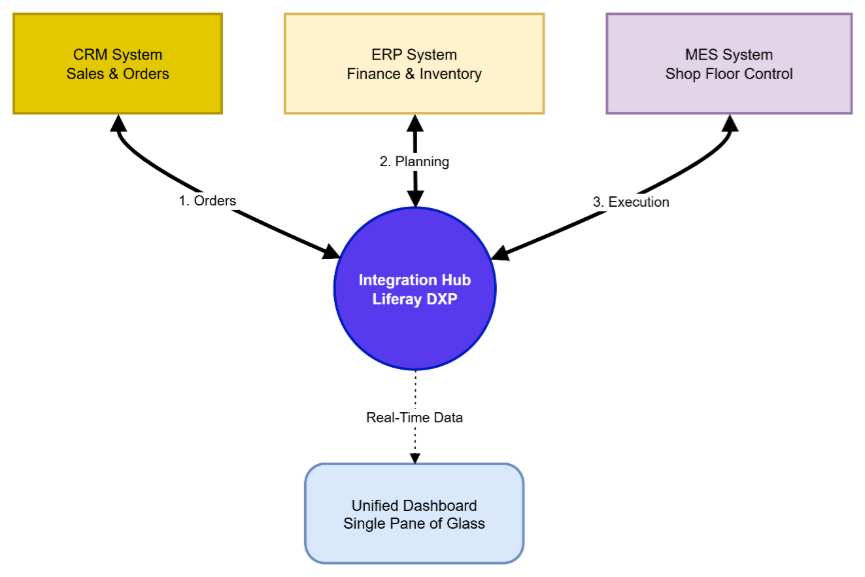
1. Establishing a Central Integration Layer
A Smart Manufacturing architecture includes a central platform that:
- Connects disparate systems via APIs
- Transforms and normalizes data
- Maintains consistent master data across systems
This layer enables real–time exchange between:
- MES shop–floor data
- ERP financial and inventory records
- CRM customer and order information
2. Standardizing Data Across Systems
Smart Manufacturing creates:
- Common definitions for products, orders, and processes
- A unified data model that all systems reference
- Shared metrics and KPIs across functions
When ERP, MES, and CRM share the same language, data flows without friction.
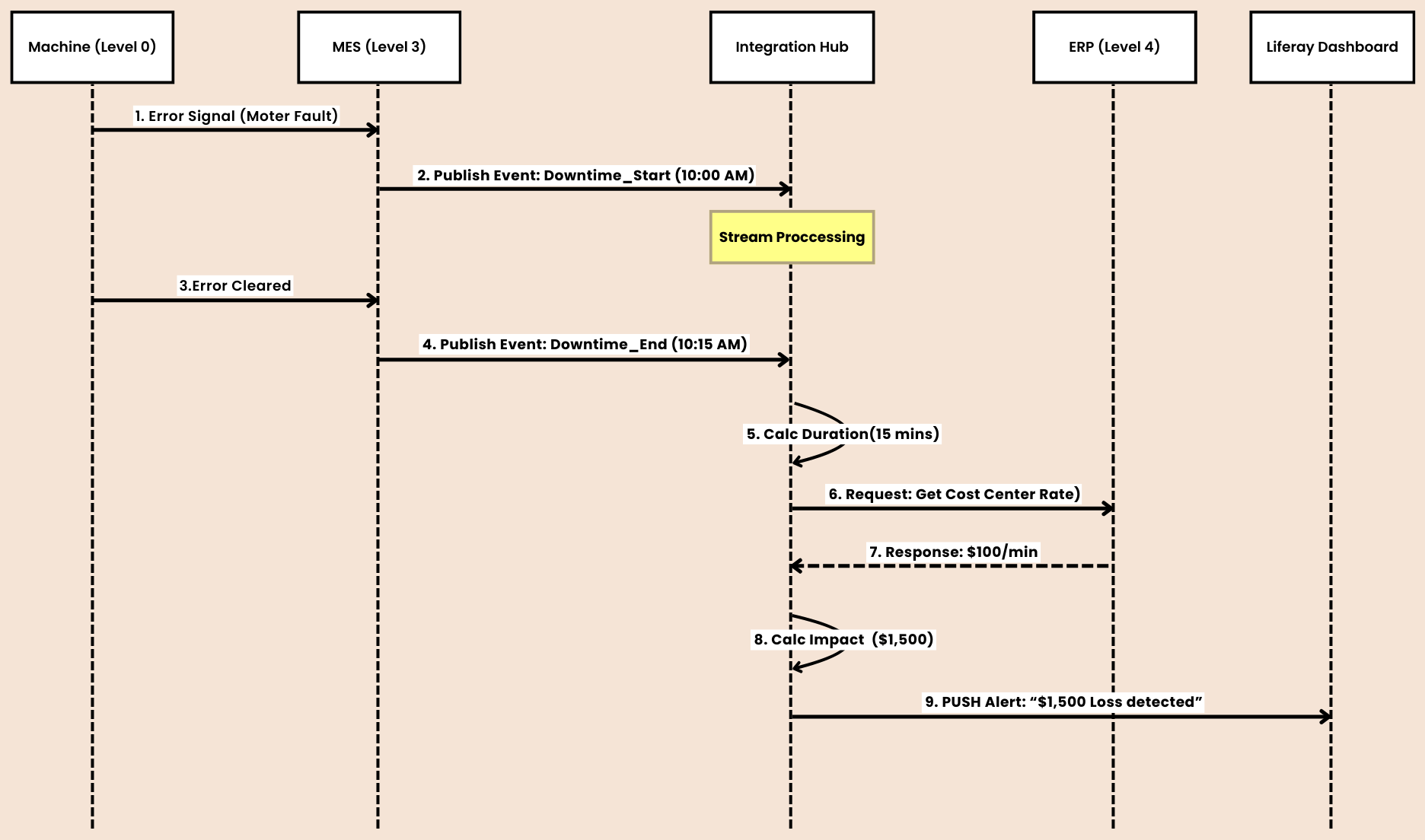
3. Enabling Event-Driven Workflows
Instead of reactive or batch processing:
- Order creation in CRM triggers automatic planning in ERP
- Production starts in MES based on finished goods demand
- Quality exceptions automatically alert CRM service reps
All workflows are coordinated in real time.
4. Providing a Unified Operational View
Executives and managers gain dashboards that show:
- Demand forecasts
- Order fulfillment statuses
- Production KPIs
- Inventory and material flow
- Customer sentiment and delivery timelines
This eliminates guesswork and accelerates decisions.
The Role of Liferay in Smart Manufacturing Integration
Liferay is a flexible digital experience platform that acts as a central connective layer between ERP, CRM, and MES systems - while also providing a unified user experience.
Here’s how Liferay fits into Smart Manufacturing:
1. Unified Integration Hub
Liferay can:
- Connect via APIs to ERP systems like Oracle NetSuite, SAP, and Microsoft Dynamics
- Interface with CRM platforms like Salesforce or Dynamics CRM
- Integrate with MES platforms through connectors, APIs, or middleware
It doesn’t replace existing systems – it unifies them.
2. Centralized Dashboards and Portals
Instead of asking users to log into multiple platforms:
- Liferay surfaces all relevant data in one portal
- Custom dashboards provide role–based visibility for executives, planners, operators, and sales teams
- Real–time KPI widgets bring operational intelligence to every stakeholder
3. Role-Based Access and Security
With single sign-on (SSO) and granular access control, Liferay ensures:
- Secure access to cross–system data
- Compliance with industry standards (especially important for regulated U.S. manufacturers)
- Traceable audit logs and user permissions
4. Event and Workflow Orchestration
Liferay supports:
- Event subscriptions and triggers
- Workflow automation across systems
- Notifications and alerts integrated with business processes
5. Scalability and Modern Architecture
Built on modular principles, Liferay:
- Scales with enterprise growth
- Reduces dependency on custom point–to–point integrations
- Improves total cost of ownership compared to hard–wired system connections
ERP vs CRM vs MES vs Liferay - A Practical Comparison
Here’s a comparison table that illustrates the strengths and limitations of each system in a Smart Manufacturing context:
| Aspect / Capability | ERP | CRM | MES | Liferay (Integration Layer) |
|---|---|---|---|---|
| Primary Focus | Business operations & financials | Customer engagement & sales | Production execution & control | Unified experience & integration across systems |
| Data Ownership | Financials, inventory, procurement | Customer, order, service data | Shop-floor status, quality, output | Aggregated data from all systems |
| Real-Time Production Visibility | Limited | None | Yes | Yes (aggregated from MES + others) |
| Unified Reporting | Domain-specific reporting | Sales & service reporting | Operational reporting | Cross-system dashboards |
| User Experience (UX) | Functional, ERP-centric | Sales-centric | Technical, shop-floor | Role-based, unified across systems |
| Master Data Consistency | Needs governance | Needs governance | Needs governance | Central master data framework |
| Integration Capability | Varies; may require middleware | Varies; may require middleware | Varies; often proprietary | Built-for integration (APIs, connectors, orchestration) |
| Best Fit | Finance, inventory, compliance | Customer acquisition & retention | Execution, quality, production control | Data orchestration, unified workflows & dashboards |
| Typical Bottlenecks Without Integration | Delayed planning & order updates | Missed customer visibility | Data isolation from business context | N/A - solves the bottlenecks |
How Smart Manufacturing Works in Practice (U.S. Case Example)
Let’s walk through a realistic example relevant to American manufacturers -
1. New Order Creation (CRM)
A U.S. manufacturer’s sales rep logs a new order for custom parts in Salesforce (CRM).
Smart Manufacturing action: CRM pushes the order to the integration layer (Liferay).
2. Order Planning (ERP)
Liferay translates the order and sends it to the ERP (e.g., Oracle or SAP) for planning and inventory validation. Components are earmarked, and material requirements are determined.
3. Production Scheduling (MES Triggered)
ERP pushes production schedules to MES via Liferay. The MES allocates machines and resources, optimizing for bottlenecks.
4. Real-Time Execution & Monitoring (MES)
MES oversees execution:
- Tracks machine status
- Monitors quality checkpoints
- Captures OEE
Operators and supervisors see dashboards within Liferay that reflect live MES data.
5. Customer Updates (CRM)
When production is complete, MES updates ERP through Liferay. ERP updates CRM with delivery dates and shipment tracking - enabling sales support to communicate accurate ETAs to customers.
6. Analytics and Continuous Improvement
Cross-system analytics (via Liferay dashboards) highlight trends such as:
- Lead times
- Quality defect rates
- Forecast vs actual production
This enables strategic planning by leadership.
Top Business Benefits for North American Manufacturers
Smart Manufacturing integration delivers measurable advantages:
1. Real-Time End-to-End Visibility
Companies can see exactly where orders are in the pipeline - from quote to finished goods.
2. Increased Forecast Accuracy
Demand signals from CRM + production data from MES + supply data from ERP improve forecast reliability - a major advantage in volatile supply chains.
3. Faster Lead Times and On-Time Delivery
Automated workflows reduce delays and errors.
4. Higher Customer Satisfaction
Sales teams have accurate status information and delivery estimates - a competitive differentiator in the U.S. market.
5. Reduced Operational Costs
Less manual reconciliation means fewer errors, re-works, and schedule conflicts.
6. Better Compliance and Traceability
Regulated U.S. manufacturers (e.g., aerospace, medical device) benefit from traceable records and audit trails.
How Nirvana Lab Can Help You With Smart Manufacturing
Transforming siloed systems into a collaborative, intelligent ecosystem is a strategic initiative - and it requires expertise, technology, and execution excellence.
Nirvana Lab specializes in enabling Smart Manufacturing for U.S. and North American Manufacturers. Their team brings:
1. Enterprise Integration Strategy
Designing roadmaps that ensure ERP, CRM, MES, and other systems communicate reliably.
2. Liferay-Based Integration Platforms
Building secure, scalable portals that connect systems and empower users with unified dashboards.
3. API Design & Middleware Development
Connecting older legacy systems with modern platforms without replacing core systems.
4. Real-Time Metrics & Analytics
Delivering cross-system dashboards that provide executives with actionable insights.
5. Digital Transformation Consulting
Aligning business objectives, technology choices, and execution plans.
If you’re ready to modernize your manufacturing systems and eliminate data silos, explore how Nirvana Lab can help here.
Frequently Asked Questions
Why don’t ERP, CRM, and MES communicate out of the box?
Most enterprise systems were designed independently with unique data structures and update mechanisms. They lack shared data models and real–time integration capabilities without additional middleware.
Can modern cloud ERP or CRM platforms solve this without integration?
While cloud systems often provide better APIs, without a central orchestration layer and normalized master data, true real–time integration remains challenging.
How long does it take to implement a Smart Manufacturing integration strategy?
Implementation timelines vary based on your existing systems, data complexity, and business priorities. A phased approach with clear milestones is recommended.
Do we need to replace our existing systems to achieve integration?
No. Smart Manufacturing emphasizes connecting systems rather than replacing them. Legacy systems can be integrated through platforms like Liferay and middleware.
How does Liferay differ from traditional integration platforms?
Liferay not only connects systems but also delivers unified user experiences, role–based dashboards, and secure access – making it both an integration and user engagement layer.
What KPIs improve after integration?
Common improvements include on–time delivery, forecast accuracy, production cycle times, inventory turns, and customer satisfaction scores.
Is Smart Manufacturing only for large enterprises?
Not at all. Even small and mid–sized manufacturers see benefits from streamlined data flows, reduced errors, and unified reporting.