In today’s fast-paced digital landscape, building scalable, high-performance microservices is essential for enterprise systems. Spring Boot, a popular Java-based framework, paired with gRPC, a high-performance RPC framework, offers a robust solution for creating efficient and cost-effective microservices. This article explores the integration of gRPC with Spring Boot to design cloud-native architectures and examines how this combination outshines traditional REST-based approaches.
Introduction to gRPC and Spring Boot Microservices
Overview of gRPC and Its Benefits
gRPC, or Google Remote Procedure Call, is a modern, high-performance communication protocol developed by Google. It leverages HTTP/2 for transport and Protocol Buffers (Protobuf) as its interface definition language. Some key benefits of gRPC include:
Low latency and high throughput: Ideal for real-time applications.
Cross-platform support: gRPC can be implemented in multiple programming languages.
Efficient serialization: Using Protobuf ensures compact and fast message exchange.
Why Spring Boot Is Ideal for Microservices
Spring Boot is widely regarded as a go-to framework for building microservices due to its simplicity and rich ecosystem. It simplifies dependency management, configuration, and deployment, making it easier to focus on application logic. Spring Boot's seamless integration with gRPC further enhances its ability to build high-performance microservices.
The Role of High-Performance Communication in Enterprise Architectures
In enterprise microservice architectures, communication between services often becomes a bottleneck. High-performance communication frameworks like gRPC play a critical role by minimizing latency and bandwidth usage, enabling enterprises to scale their systems efficiently.
Core Concepts: Protocol Buffers and gRPC Communication Types
What Are Protocol Buffers (Protobuf)?
Protobuf is a language-neutral, platform-neutral mechanism for serializing structured data. It is the backbone of gRPC and ensures that messages exchanged between services are compact and efficient. Protobuf schemas define the structure of data, making it easy to generate code for different programming languages.
Unary RPCs and When to Use Them
Unary RPCs are the simplest form of gRPC communication where the client sends a single request, and the server responds with a single reply. This method is ideal for straightforward interactions, such as fetching data or submitting a form.
Server Streaming and Implementing the Server Streaming Service
In server streaming, a client sends a request, and the server provides multiple responses as a stream. This is particularly useful for use cases like sending real-time updates or logs. Implementing server streaming in gRPC involves defining the stream in the Protobuf schema and writing server-side logic to handle the stream of responses.
Client Streaming and Handling a Stream of Requests from the Client
Client streaming enables a client to send a stream of requests to the server, which processes them and sends back a single response. This is beneficial for batch processing or aggregating data from multiple sources.
Bidirectional gRPC Communication Use Cases
Bidirectional streaming allows both client and server to exchange a continuous stream of messages. This type of communication is perfect for chat applications, collaborative tools, or any scenario requiring real-time, two-way data transfer.
Designing Cloud-Native Microservice Architectures with Spring Boot and gRPC
Principles of Cloud-Native Architecture
Cloud-native architectures emphasize scalability, resilience, and dynamic management. They leverage containerization, microservices, and automation to deliver flexible, distributed systems.
Integrating gRPC with Spring Boot
Spring Boot's modularity and ease of configuration make it an excellent choice for integrating gRPC. Developers can use libraries like grpc-spring-boot-starter to simplify gRPC integration, enabling seamless communication between services in cloud-native architectures.
Scalability in Enterprise Microservice Architecture
Scalability is a cornerstone of cloud-native microservices. By leveraging gRPC's low-latency communication and Spring Boot's robust framework, enterprises can scale their architecture efficiently to meet demand.
Step-by-Step Implementation of gRPC Services in Spring Boot
Setting Up Your Spring Boot Project for gRPC
To set up a Spring Boot project for gRPC, include the necessary dependencies in your pom.xml or build.gradle file. For example, add the grpc-spring-boot-starter library (from groupId net.devh) and Protobuf plugins to streamline development. Here's a sample Maven dependency:
<dependency>
<groupId>net.devh</groupId>
<artifactId>grpc-spring-boot-starter</artifactId>
<version>3.1.0.RELEASE</version> <!– Use the latest version –>
</dependency>
You’ll also need Protobuf-related dependencies and plugins for code generation.
Defining the Service with Protocol Buffers
Create a .proto file to define your gRPC service and message types. This file acts as the blueprint for generating server and client code.
Generating Java Stubs Using Protobuf
Use the Protobuf compiler (protoc) to generate Java stubs based on your .proto file. These stubs will include service interfaces and message classes. Configure the protobuf-maven-plugin or equivalent in your build file to automate this.
Implementing the Generated Service
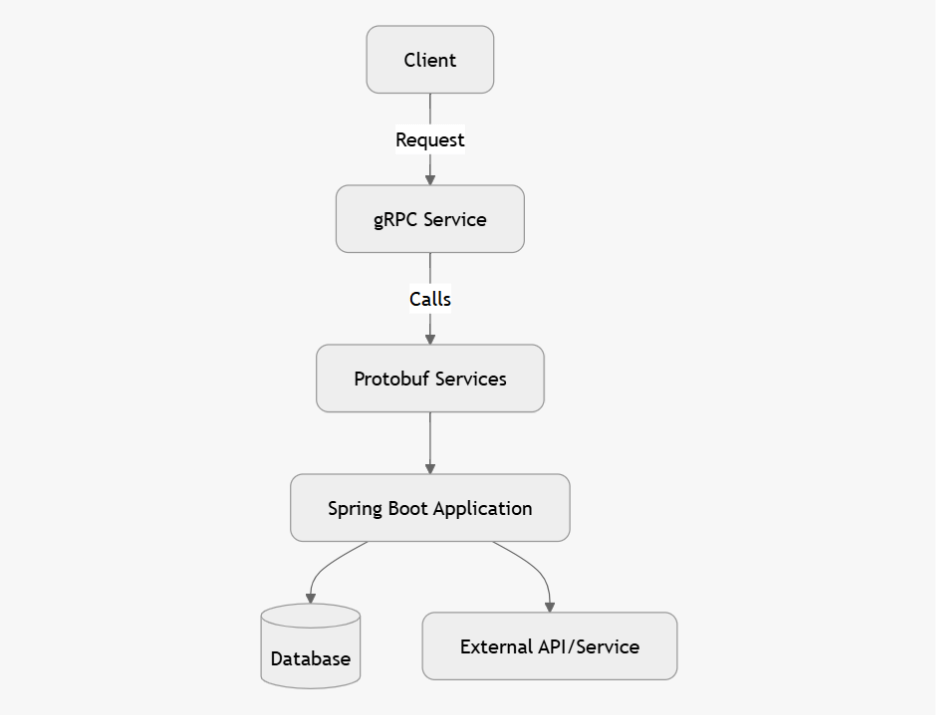
Once the stubs are generated, implement the service logic in your Spring Boot application by extending the generated abstract class. Annotate the implementation with @GrpcService to let Spring Boot automatically register and manage the service.
public class MyServiceImpl extends MyServiceGrpc.MyServiceImplBase {
@Override
public void myUnaryMethod(MyRequest request, StreamObserver<MyResponse> responseObserver) {
// Business logic
MyResponse response = MyResponse.newBuilder()
.setMessage(“Hello, ” + request.getName())
.build();
responseObserver.onNext(response);
responseObserver.onCompleted();
}
}
Configuring the gRPC Server in Spring Boot
In Spring Boot, you don't need to manually spawn the gRPC server—the grpc-spring-boot-starter handles this automatically. Configure the server port and other settings in your application.properties or application.yml file, for example: grpc.server.port=9090
Spring Boot will start the gRPC server on application startup, listening on the specified port.
Performance and ROI: Why gRPC Outshines REST
Performance Advantages of gRPC Over REST
gRPC significantly outperforms REST in terms of speed, payload size, and resource efficiency. By utilizing Protobuf, gRPC messages are smaller and faster to serialize and deserialize compared to JSON used in REST.
Cost and Resource Efficiency in Microservices
The reduced overhead of gRPC translates to lower bandwidth costs and better utilization of computational resources, making it a cost-effective choice for enterprise applications.
Security Considerations in gRPC Communication
gRPC uses HTTP/2, which supports built-in encryption and multiplexing. This enhances security while enabling multiple streams over a single connection.
Metric
gRPC
REST
Latency
Low
High
Payload Size
Compact (Protobuf)
Larger (JSON/XML)
Scalability
High
Moderate
Bandwidth Usage
High
Moderate
Security
Built-in (HTTP/2)
Depends on TLS
ROI Analysis for Enterprise Architects and Developers
Evaluating Development Effort Versus Performance
While the initial setup of gRPC and Protobuf requires effort, the long-term performance benefits and resource savings outweigh the upfront investment.
Balancing Costs and Security in Enterprise Systems
Enterprise architects must weigh the cost savings from gRPC’s efficiency against the need for robust security measures, ensuring a balanced and sustainable system.
Aspect
Development Effort
Performance
Cost
Security
Initial Setup
Medium
High
Low (Efficient)
Built-in (HTTP/2)
Long-Term Benefit
Initial effort
Gains
Reduced Bandwidth
Strong Encryption
Monitoring and Observability in gRPC Microservices
The Importance of Monitoring in Microservices
Monitoring ensures the health and performance of microservices. It helps identify bottlenecks, detect failures, and optimize system performance.
Tools for Monitoring Spring Boot gRPC Microservices
Tools like Prometheus and Grafana are widely used for tracking metrics and visualizing system performance. These tools can be integrated easily with Spring Boot.
Using Prometheus and Grafana for Observability
Prometheus collects and stores metrics from your gRPC services, while Grafana provides a user-friendly interface to visualize these metrics, enabling better observability and decision-making.
By leveraging these tools, you can ensure your gRPC-based microservices perform optimally in production environments.
You’ll also need Protobuf-related dependencies and plugins for code generation.
Frequently Asked Questions
What Are the Benefits of Using gRPC with Spring Boot?
Using gRPC with Spring Boot offers low latency and high throughput communication, efficient serialization with Protocol Buffers, and seamless integration for building scalable, high-performance microservices.
How Do You Implement Protocol Buffers in a Spring Boot gRPC Service?
To implement Protocol Buffers, define your service and message types in a .proto file, use the Protobuf compiler to generate Java stubs, and implement the service logic in your Spring Boot application by extending the generated abstract class and annotating it with @GrpcService.
How Does gRPC Improve Microservice Communication Performance?
gRPC improves performance by leveraging HTTP/2 for low latency and multiplexing, and by using Protocol Buffers for compact and fast message serialization, resulting in efficient communication and reduced resource usage.
What Are the Best Practices for Building Scalable gRPC Services in Spring Boot?
Best practices include leveraging Spring Boot’s modularity for clean integration, properly defining .proto files, optimizing server configuration via properties, and ensuring efficient resource usage through gRPC’s high-performance features.
What Tools Can Be Used for Monitoring Spring Boot gRPC Microservices?
Tools like Prometheus and Grafana can be integrated to monitor Spring Boot gRPC microservices, providing metrics collection and visualization for better observability.