Nirvana Lab

Home / Blog / Observability First: Why DevOps Teams Are Shifting from Monitoring to Full-Stack Observability 
Table of Contents

Observability First: Why DevOps Teams Are Shifting from Monitoring to Full-Stack Observability 

The way modern systems behave has changed dramatically, and DevOps teams can no longer rely on traditional dashboards and static alerts to stay ahead. This shift is now reshaping how engineering and business leaders think about performance, reliability, and digital experience. 


Modern platforms demand visibility that goes far deeper than CPU graphs and error counts. And that’s exactly why full stack observability has become central to DevOps Observability 2025. 

Why Monitoring No Longer Matches Modern DevOps Needs

Legacy methods were built for a world that was simpler, slower, and easier to predict. Today’s environments are distributed, dynamic, and constantly evolving, which demands a more exploratory approach to understanding system behavior.

Before diving deeper, let’s set the stage for what makes observability a step change rather than an incremental improvement.

Monitoring tells you what happened. Observability tells you why

Monitoring works when you already know what signals to track. It’s reactive by design. Observability accepts that systems fail in unpredictable ways and helps teams uncover the true cause without predefining every possible scenario.

Modern architectures make old methods insufficient

Microservices, multi cloud setups, serverless components, and distributed data pipelines introduce too many unknowns for threshold based monitoring to catch.

This widening gap explains why the Observability vs Monitoring shift by DevOps teams has accelerated globally.

DID YOU KNOW

The global Observability Tools and Platforms Market is projected to grow from USD 2.4 billion in 2023 to USD 4.1 billion by 2028, registering a CAGR of 11.7%. . 

The Core Difference in Simple Terms

As organisations adopt cloud native architectures, understanding the distinction between the two approaches becomes essential. Decision makers now evaluate solutions based on insight depth, not just dashboard availability.

Here’s a clear comparison that captures the difference.

Monitoring vs Observability in DevOps

Area Monitoring Observability
Primary goal Detect known issues Explore and understand unknown issues
Data signals Metrics only Metrics, logs, traces, events, profiling
Architecture fit Static systems Distributed, cloud native systems
Troubleshooting Reactive Proactive and investigative
Insight depth Surface symptoms Underlying causes and dependencies
DevOps benefit Basic visibility Faster decisions and deeper intelligence

This table illustrates why DevOps Observability 2025 is less about tooling and more about capability. Observability provides a complete lens into system behavior end to end. 

The Real Drivers Behind the Shift

Teams aren’t embracing observability because it’s trendy. They're doing it because the cost of operating without it has become too high. Outages hurt revenue. Latency hurts conversions. Slow rollouts hurt customer trust.

Let’s break down what’s pushing engineering leaders toward an observability first approach.

1. Complex systems require deeper visibility

Microservices, asynchronous workflows, and distributed data create too many unknowns for monitoring alone to surface. Observability pieces these signals together into one narrative.

2. Faster troubleshooting reduces customer impact

Traditional monitoring stretches war room timelines because teams pivot between isolated signals. Observability cuts through the noise and reduces mean time to detect and resolve.

4. Business and engineering alignment strengthens

Leaders don’t just see service health anymore. They see how reliability affects churn, conversions, SLAs, and revenue.

5. AI driven automation needs richer telemetry

AI models thrive on context. Observability provides exactly those connected signals that make intelligent alerting and automated remediation possible.

What This Shift Means for DevOps Leaders

Adopting observability is not a tool migration. It’s a cultural and operational evolution. When done right, it changes how teams collaborate, deploy, and make decisions across the engineering lifecycle.

Here are the outcomes leaders consistently report.

What This Shift Means for DevOps Leaders

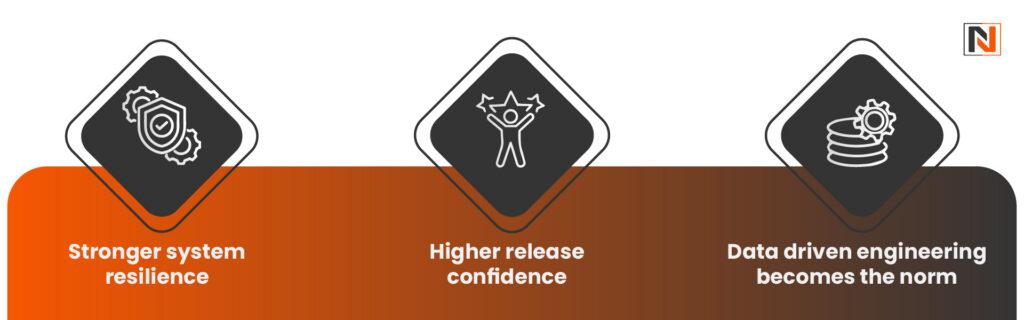
1. Stronger system resilience

Teams catch anomalies early, understand failure patterns, and prevent problems before they reach customers.

2. Higher release confidence

Observability validates system behavior during every deployment phase, enabling faster rollouts with fewer rollbacks.

3. Data driven engineering becomes the norm

When teams stop guessing and start correlating, engineering moves from reactive firefighting to proactive improvement.

Practical Examples of Observability in Action

Real value emerges when observability helps teams understand issues they couldn’t diagnose before. These examples reflect common scenarios across digital businesses.

Here’s what this looks like in the real world.

1. Slow checkout in an ecommerce platform

Monitoring shows rising latency - Observability traces the request path, identifies a database lock, and highlights the exact microservice affected.

2. Unexpected spike in 500 errors

Monitoring raises alerts - Observability maps the chain of events to an API gateway misconfiguration tied to a new deployment.

3. Gradual performance degradation

Monitoring stays silent because no thresholds break - Observability correlates subtle changes in garbage collection cycles with a recent code push.

These examples capture the benefits of observability for DevOps in a way numbers alone cannot.

How DevOps Teams Can Make the Shift Successfully

Moving from monitoring to observability doesn’t need to be overwhelming. The key is to think in capabilities, not tools. Start small but start meaningfully.

Here’s a practical progression leaders use.

1. Start with distributed tracing

If there’s a single capability that defines modern observability, it’s tracing. It unifies logs, metrics, and performance signals into a complete story.

2. Standardize instrumentation

Adopt open telemetry. Make signals consistent across every service and layer.

3. Correlate insights, not dashboards

The goal is not to add more visualizations. It’s to connect signals so that teams can detect patterns quickly.

4. Build observability into development

Treat observability as part of engineering, not just operations. Use it during builds, tests, and canary rollouts.

5. Link observability to business outcomes

When leaders see the connection between reliability and revenue, observability becomes a strategic priority rather than a technical upgrade.

The Bottom Line

Monitoring still matters but it can no longer carry the weight of modern distributed systems on its own. The shift toward full stack observability reflects a broader reality: organisations need deeper, faster, and more contextual insights to stay competitive.

That’s why the Observability vs Monitoring shift by DevOps teams has become a defining movement in the global engineering landscape. It helps teams ship faster, recover smarter, and protect customer experience more effectively than ever.

Looking ahead to DevOps Observability 2025, companies that embrace observability first will build stronger digital foundations, reduce operational risk, and enable the next generation of AI powered automation.

Observability isn’t just an upgrade. It’s becoming the operating system of modern DevOps.
Frequently Asked Questions ​

What is the main difference between monitoring and observability?

Monitoring tells you what happened using predefined metrics. Observability helps you understand why it happened by correlating logs, metrics, traces, and events. 

Because modern systems are distributed and unpredictable, observability gives deeper visibility, faster troubleshooting, and better alignment with business outcomes.

It connects signals across services, making it easier to pinpoint root causes quickly and prevent issues before they impact users.

No. It’s a mindset shift. It changes how teams instrument code, debug issues, measure performance, and plan releases.

Improved customer experience. Faster resolution, fewer incidents, and more reliable digital services directly protect revenue and retention.Lorem ipsum dolor sit amet, consectetur adipiscing elit. Ut elit tellus, luctus nec ullamcorper mattis, pulvinar dapibus leo.

Author