Updating legacy enterprise portals is a huge step for any business looking to stay ahead and scale up safely. We all know that outdated systems often create bottlenecks, but modern technology offers a way out–helping you break down data silos and streamline your IT integration. Let’s take look at the key strategies you need to modernize your systems effectively.
Understanding Legacy System Modernization
What is modernization of legacy systems?
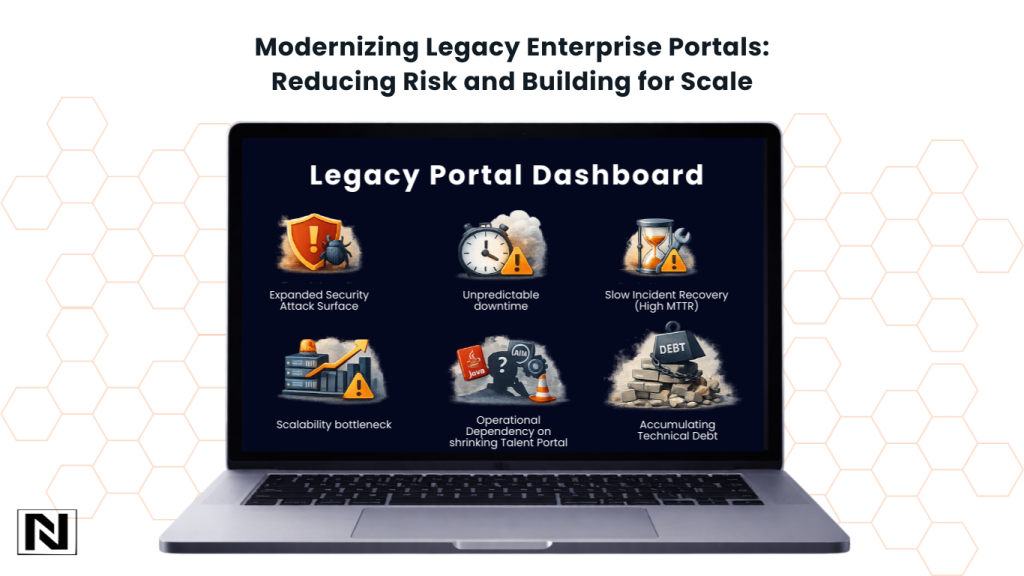
Modernizing legacy systems is a way to revitalize business technology. It entails updating necessary but antiquated software to meet the demands of the modern market. Modernizing outdated systems guarantees that the company remains quick, effective, and safe in a constantly shifting market because they are frequently inflexible and difficult to scale.
Why update outdated corporate portals?
Businesses must update their legacy enterprise portals if they want to stay flexible and competitive. Inefficiencies, security flaws, and difficulties integrating more recent technologies, such as microservices and APIs, can result from outdated systems. Businesses can improve scalability for long-term growth, lower risk, and streamline operations by modernizing.
Key Strategies for Reducing Risk in Modernization
Identifying and addressing data silos
Data silos emerge when information is locked within specific systems or departments, limiting visibility and collaboration. This fragmentation slows decision-making and often leads to duplicated efforts and inconsistent insights. During modernization, identifying where data resides and how it flows is essential to reducing risk. By integrating systems through shared platforms, APIs, or unified data models, organisations can enable seamless information exchange. Breaking down silos ultimately creates smoother workflows, stronger governance, and informed business decisions.
Building a robust IT integration strategy
A strong IT integration strategy is imperative in ensuring seamless communication between legacy systems and modern technologies. This strategy should focus on creating a centralized data integration layer that connects all components.
The diagram above shows how legacy systems can be integrated into a modern architecture, ensuring data flows smoothly across the enterprise.
Leveraging Modern Technologies for Scalability
Advantages of microservices and APIs
Microservices and APIs offer scalable and modular enterprise IT integration solutions. Microservices divide applications into smaller, more manageable components, while APIs facilitate smooth communication between systems. When combined, they provide flexibility and lessen reliance on monolithic systems.
Complying with best practices for enterprise data architecture
Scalable growth is based on enterprise data architecture. When properly constructed, it enables companies to operate more quickly, make better choices, and adjust to change with assurance. Organizations can innovate without interruption and scale smoothly rather than responding to growth challenges. In addition to supporting operations, a robust data architecture fosters long-term success and agility.
// Java code snippet demonstrating API Gateway setup
import org.springframework.boot.SpringApplication;
import org.springframework.boot.autoconfigure.SpringBootApplication;
import org.springframework.cloud.gateway.route.RouteLocator;
import org.springframework.cloud.gateway.route.builder.RouteLocatorBuilder;
@SpringBootApplication
public class ApiGatewayApplication {
public static void main(String[] args) {
SpringApplication.run(ApiGatewayApplication.class, args);
}
public RouteLocator routeLocator(RouteLocatorBuilder builder) {
return builder.routes()
.route(“legacy-system”, r -> r.path(“/legacy/**”)
.uri(“http://legacy-system”))
.route(“microservice”, r -> r.path(“/service/**”)
.uri(“http://microservice”))
.build();
}
}
This code shows how an API Gateway can facilitate scalable integrations, connecting legacy systems with modern microservices.
Modernizing the Data Layer for Better Integration
Constructing a Scalable and Efficient Data Layer
Modernizing the data layer is about creating a foundation that grows with you. A scalable architecture ensures efficient data storage, access, and sharing regardless of how rapidly volumes increase. The result? Outstanding performance without any barriers to the expansion of your business.
Ensuring the Smooth Integration of Data
When your data layer is well-designed, systems connect with ease. Teams receive real-time insights, operations run more smoothly, and information flows where it's needed. Raw data is seamlessly integrated to produce meaningful action.
// Java code snippet for microservice-based data layer
import org.springframework.web.bind.annotation.*;
import org.springframework.beans.factory.annotation.Autowired;
@RestController
@RequestMapping(“/data”)
public class DataLayerController {
@Autowired
private DataService dataService;
@GetMapping(“/{id}”)
public Data getData(@PathVariable String id) {
return dataService.retrieveData(id);
}
@PostMapping
public void saveData(@RequestBody Data data) {
dataService.saveData(data);
}
}
This snippet shows how a microservice-based data layer can support seamless integration and efficient data management.
Evaluating ROI and Cost Benefits of Modernization
Balancing costs with integration maturity
Consider the balance of costs with integration maturity levels. Evaluating the trade-offs between immediate expenses and the future-proofing of integration strategies is crucial for successful modernization.
Maximizing ROI through scalable solutions
Implement scalable solutions to enhance efficiency and optimize your return on investment over time, reducing overall operational costs.
| Integration Maturity Level | Cost | Expected ROI |
|---|---|---|
| Basic | Low | Moderate |
| Intermediate | Medium | High |
| Advanced | High | Very High |
This table highlights how integration maturity impacts costs and ROI, enabling businesses to make informed decisions during modernization.
To lower risk and prepare for expansion, modernizing legacy corporate portals is a difficult but essential process. Businesses can convert antiquated systems into scalable, effective solutions while guaranteeing cost-effective integration by utilizing contemporary technologies like APIs, microservices, and sophisticated data structures.
Frequently Asked Questions
What does modernizing outdated systems entail?
The process of updating outdated technology to better meet the demands of your company today is known as modernization. Modernization can update existing applications, boost operational efficiency, and enhance the flexibility and scalability of systems.
In what ways does modernization reduce risk and increase company value?
By locating and fixing inefficiencies in current applications, system modernization assists businesses in reducing technical risk. Additionally, by removing departmental and data silos, modernization can reveal latent corporate value.
Which enterprise application modernization techniques have been shown to work?
Using APIs and microservices, upgrading your data layer, removing data silos, and developing an IT integration strategy are a few tried-and-true tactics.
How can I tell if it's time to update my outdated systems?
If your systems are ineffective, cannot be integrated with new technology, present security problems, or cannot grow with your company, you might want to think about updating.
When modernizing, how can I lower my technical debt?
By emphasizing scalable solutions, putting in place a contemporary business data architecture, and striking a balance between costs and integration maturity, you may lower technical debt.