If you’ve worked on a Liferay Commerce 7.4 implementation for any serious B2B client, you know the feeling.
Dev goes great. You test your product import logic with a CSV of 500 items. It’s fast, snappy, and works like a charm. Then comes UAT (or worse, Production). The client hands you the real master data file – 50,000, 100,000, or maybe 250,000 SKUs. You hit “Import,” and then… silence.
The logs stop moving. The CPU spikes to 100%. The UI freezes. And eventually, you get the dreaded java.lang.OutOfMemory Error or a transaction timeout.
We’ve seen this scenario play out at Nirvana Lab more times than we can count. The reality is that bulk product imports are the single most underestimated performance challenge in enterprise eCommerce.
In this post, I’m going to skip the marketing fluff and walk you through the exact High-Performance Import Architecture we use to process 100k+ SKUs in under 40 minutes—stable, repeatable, and crash-free.
- The Monolithic Transaction: By default, Liferay tries to wrap the whole request in one transaction. If you have 50k items, you are asking the database to hold 50k uncommitted inserts in a rollback segment.
- Hibernate Session Bloat: Hibernate loves to cache. As you iterate, every single CPDefinition object stays in the “First-Level Cache” (Heap Memory). It doesn’t get garbage collected because the transaction hasn’t closed.
- The Indexing Storm: This is the silent killer. Every time you add a product, the Indexer wakes up to update Elasticsearch/Solr. Doing this 100,000 times synchronously is performance suicide.
The result? A system that works fine for small catalogs but falls off a cliff as soon as you hit enterprise scale.
1. Get Off the Request Thread
Never run a bulk import on the main HTTP thread. If the browser disconnects or the load balancer times out, your import dies in a zombie state.
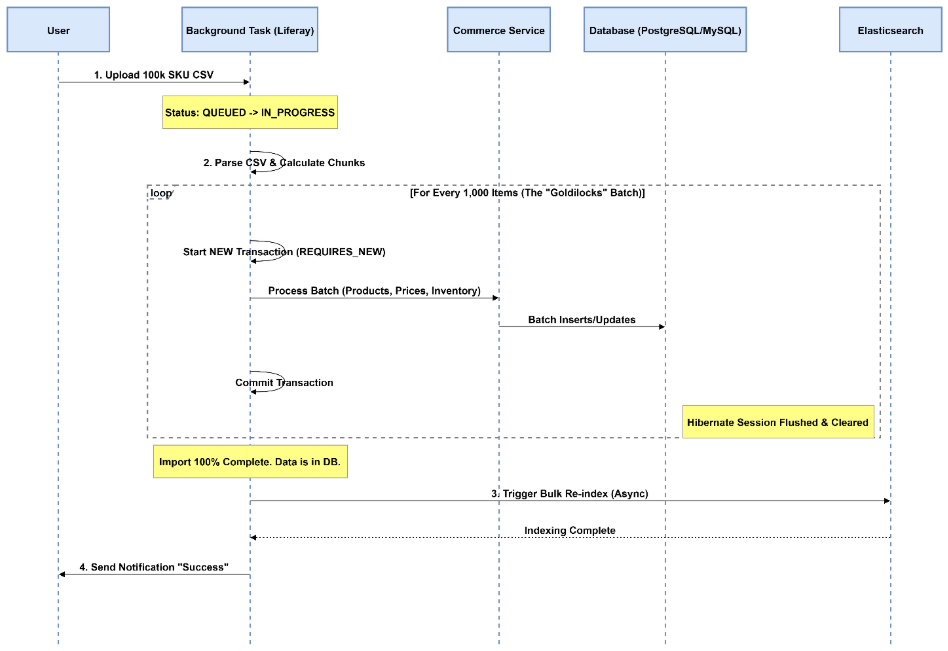
We use Liferay’s BackgroundTaskExecutor framework. It gives us cluster safety (if one node dies, another picks it up) and built-in status reporting.
@Component(
property = “background.task.executor.class.name=com.nirvanalab.commerce.task.ProductImportTaskExecutor”,
service = BackgroundTaskExecutor.class
)
public class ProductImportTaskExecutor extends BaseBackgroundTaskExecutor {
// Implementation logic here…
}
2. The “Goldilocks” Chunking Strategy
We don’t pass the whole list to the processor. We slice it.
Through extensive benchmarking on Liferay DXP 7.4, we found that a batch size of 500 to 1,000 products is the sweet spot.
- Too small (<100): You waste time opening/closing transactions.
- Too big (>5000): The Hibernate dirty-checking mechanism starts to slow down exponentially.
// The “Outer Loop” inside your Background Task
public void executeImport(List<ProductRow> allRows) {
int batchSize = 1000;
for (int i = 0; i < allRows.size(); i += batchSize) {
int end = Math.min(allRows.size(), i + batchSize);
List<ProductRow> batch = allRows.subList(i, end);
// This is where the magic happens
_batchService.processBatchInNewTransaction(batch);
// Help the Garbage Collector
batch.clear();
}
}
Note: Batch Engine as the preferred modern alternative.
3. Transaction Isolation (The Secret Sauce)
This is the most critical part. You must ensure that each batch commits to the database immediately.
If you just call a method, it might inherit the parent transaction. You need to force a new physical transaction using Propagation.REQUIRES_NEW.
@Transactional(propagation = Propagation.REQUIRES_NEW)
public void processBatchInNewTransaction(List<ProductRow> batch) {
for (ProductRow row : batch) {
// Create Product, set Price, set Inventory
// …
}
// When this method exits, the DB commits and Hibernate flushes.
// Memory is released.
}
4. Defer the Indexing
If you try to index 100k products one by one, your import will take 5 hours.
During the import, we disable the auto-reindexing triggers (use IndexerWriterHelper or set the model-specific indexing to delayed/batch mode if available). We let the data go into the database “dark” (unsearchable). Once the loop finishes, we trigger a manual, optimized bulk re-index.
// Run this ONLY after the loop finishes
Indexer<CPDefinition> indexer = IndexerRegistryUtil.getIndexer(CPDefinition.class);
indexer.reindex(CPDefinition.class.getName(), companyId);
- Our advice: Stick to single-threaded sequential chunks. It’s fast enough. Complexity breeds bugs.
- Our advice: Run a Data Pass first (SKUs, Prices, Stock), and then run a separate Media Pass to attach images.
Frequently Asked Questions